
From Oil Tankers to Tech Teams: How the Middle East Crisis Could Reshape the IT Industry | Savishty
When oil prices jumped more than 9% in a single day this week, most people assumed it was a story for energy traders and economists.
The IT industry probably wasn't the first thing that came to mind.
But global markets have a funny way of connecting dots that seem unrelated.
A conflict in the Middle East can eventually influence hiring decisions in Bengaluru, cloud spending in London, and technology investments in New York.
That's the world we live in now.
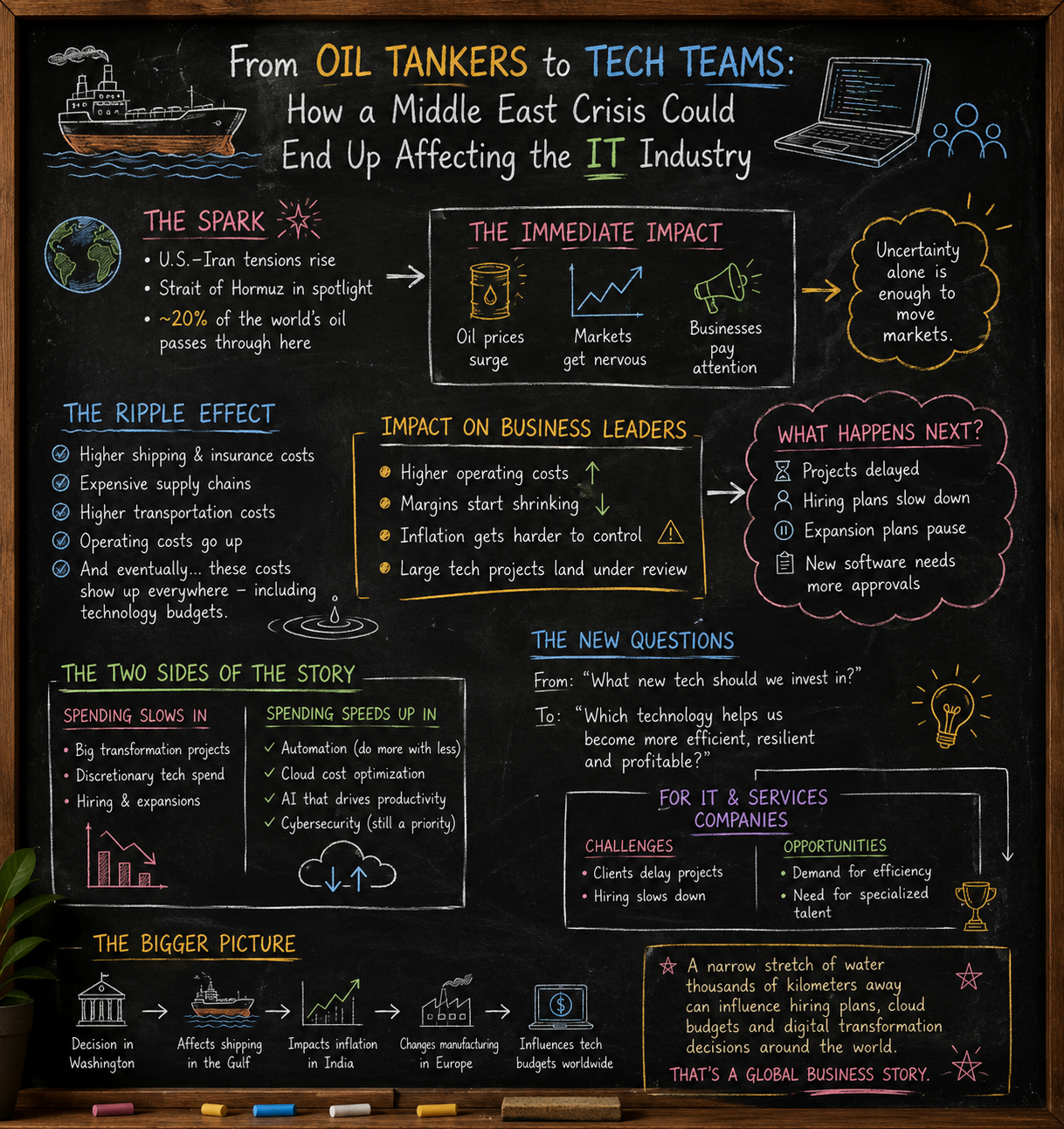
The latest tensions between the U.S. and Iran have once again put the Strait of Hormuz under the spotlight — a narrow shipping route through which nearly a fifth of the world's oil passes.
The result was immediate.
Oil prices surged.
Markets became nervous.
Businesses started paying attention.
Because oil doesn't need to disappear for prices to rise.
Uncertainty alone is enough.
Shipping companies charge higher premiums.
Insurance costs increase.
Supply chains become more expensive to operate.
And eventually those costs begin showing up everywhere else.
Including technology budgets.
For business leaders, rising oil prices usually mean one thing: prepare for higher operating costs.
Transportation gets expensive.
Manufacturing costs rise.
Inflation becomes harder to control.
Margins start shrinking.
And when companies begin looking for areas to manage spending, large technology projects often land under review.
Not because technology isn't important.
Because every investment suddenly needs a stronger business case.
Projects that looked like priorities six months ago are pushed to the next quarter.
Hiring plans become more conservative.
Expansion plans slow down.
New software purchases go through additional approvals.
Anyone who worked in tech during previous periods of economic uncertainty has seen this happen before.
But there is another side to the story.
While some technology spending slows down, other areas become even more important.
Automation becomes attractive because companies want to achieve more without increasing headcount.
Cloud cost optimization moves from being a technical discussion to a boardroom discussion.
AI projects that can improve productivity or reduce costs suddenly receive more attention.
Cybersecurity budgets remain protected because businesses understand that security incidents are expensive regardless of economic conditions.
In difficult times, technology doesn't disappear.
It evolves.
The focus shifts from innovation for the sake of innovation to innovation with measurable outcomes.
The question changes from:
"What new technology should we invest in?"
to
"Which technology helps us become more efficient, more resilient, and more profitable?"
For IT services firms, staffing companies, and consulting organizations, this creates both challenges and opportunities.
Some clients delay projects.
Others accelerate automation initiatives.
Some reduce hiring.
Others look for specialized talent that can help optimize costs and improve efficiency.
The winners are usually the companies that solve business problems rather than simply selling technology.
Perhaps that's the biggest lesson from this week's oil shock.
The modern economy is deeply interconnected.
A decision made in Washington can affect shipping routes in the Gulf, inflation in India, manufacturing in Europe, and technology budgets around the world.
The distance between geopolitics and IT is much smaller than it appears.
And sometimes, a narrow stretch of water thousands of kilometers away can end up influencing the next hiring plan, cloud migration project, or digital transformation initiative.
That's not just an oil story.
That's a global business story. suggest engaging blog title seo related
Did you find this helpful?