AI Stocks Are Cooling Down. Does That Mean the AI Boom Is Over? | Savishty
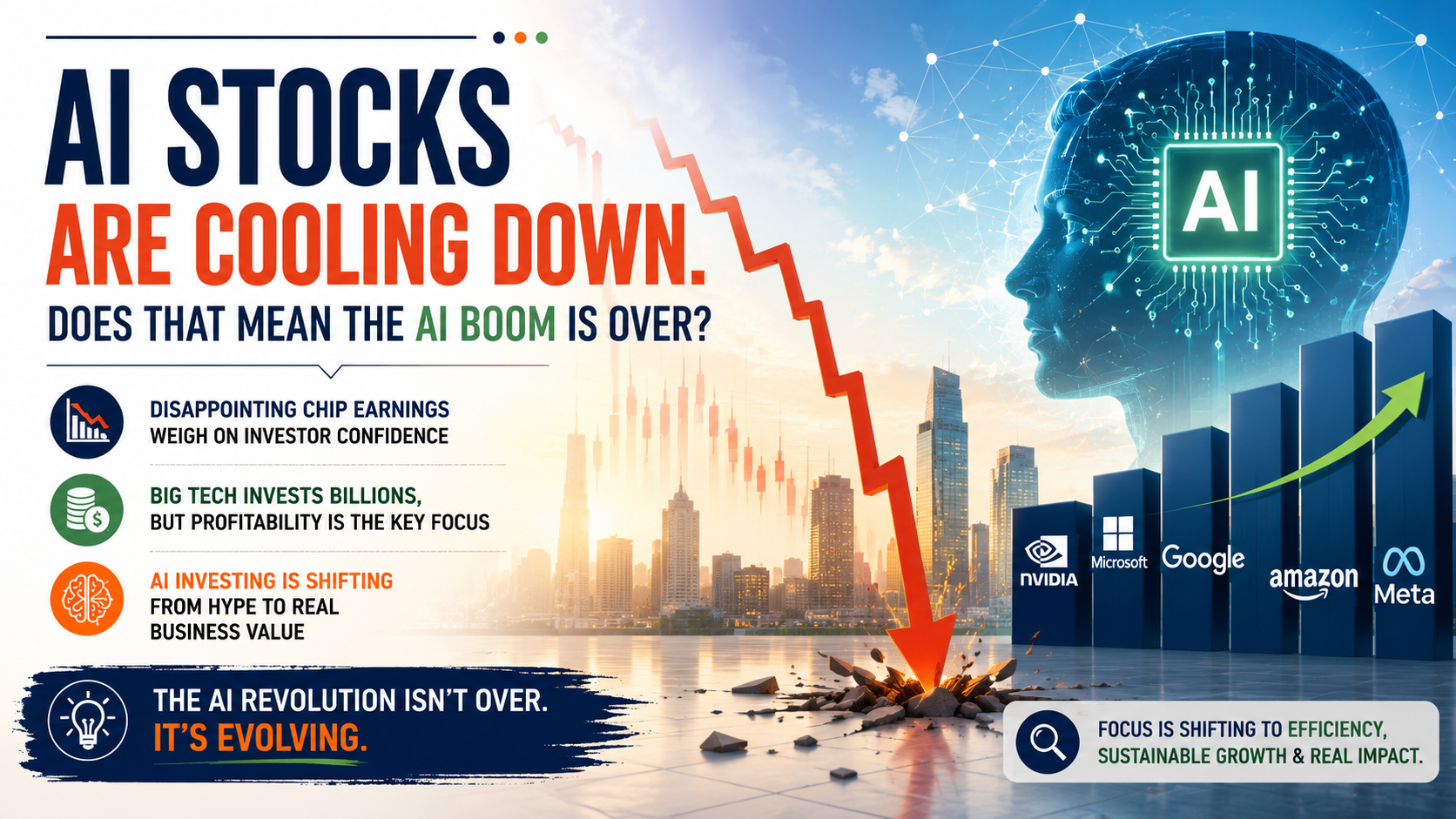
AI Stocks Are Cooling Down. Does That Mean the AI Boom Is Over?
Over the past two years, AI has been the biggest story in technology—and on Wall Street. Companies poured billions into AI infrastructure, investors rushed to buy anything linked to artificial intelligence, and chipmakers became some of the world's most valuable businesses.
But the mood is beginning to change.
Recent earnings from the semiconductor industry have put AI stocks under pressure, raising a question that investors and
Over the past two years, AI has been the biggest story in technology and on Wall Street. Companies poured billions into AI infrastructure, investors rushed to buy anything linked to artificial intelligence, and chipmakers became some of the world's most valuable businesses.
But the mood is beginning to change.
Recent earnings from the semiconductor industry have put AI stocks under pressure, raising a question that investors and business leaders can't ignore:
Has the AI boom started to slow down, or is this simply the next phase of growth?
The Market Is Looking Beyond the Hype
For a long time, announcing an AI strategy was enough to excite investors. Today, that's no longer the case.
Markets are asking tougher questions:
Is AI generating real revenue?
When will these massive investments start paying off?
Can companies maintain profit margins while spending billions on AI infrastructure?
The excitement around AI hasn't disappeared. Investors are simply expecting proof that AI can deliver sustainable business results.
Chipmakers Are Feeling the Pressure
Semiconductor companies sit at the heart of the AI revolution. Every AI model, cloud platform, and intelligent application depends on powerful chips.
However, recent earnings from the sector have disappointed the market. Growth remains strong compared to previous years, but it hasn't matched the sky-high expectations investors had built into stock prices.
When expectations become unrealistic, even good results can lead to falling share prices.
This is exactly what we're seeing today.
Big Tech Faces a New Challenge
Companies like Microsoft, Google, Meta, Amazon, and OpenAI continue investing heavily in AI.
Data centres are expanding.
New AI models are being released.
Businesses are integrating AI into almost every product they build.
The challenge isn't innovation—it's profitability.
Executives now have to convince shareholders that today's AI spending will become tomorrow's revenue.
That balance between innovation and financial discipline is becoming one of the biggest stories in the technology industry.
AI Spending Isn't Stopping—It's Becoming Smarter
A falling stock price doesn't necessarily mean AI adoption is slowing.
In fact, many businesses are moving from experimentation to practical implementation.
Instead of asking,
"Can we use AI?"
companies are asking,
"Where will AI create measurable business value?"
This shift is leading to more focused investments in areas such as:
Customer support automation
Software development
Healthcare diagnostics
Financial risk analysis
Manufacturing and supply chain optimisation
Enterprise productivity tools
Businesses are becoming more selective, choosing projects with clear returns rather than investing in AI simply because it's the latest trend.
What This Means for Businesses
For technology leaders, the current market offers an important lesson.
AI should no longer be viewed as a marketing headline.
It should be treated as a business strategy.
Organisations that connect AI initiatives to measurable outcomes whether reducing costs, improving customer experience, or increasing productivity will be in a stronger position than those chasing every new AI trend.
The Opportunity Is Still Huge
History shows that transformative technologies rarely grow in a straight line.
The internet experienced crashes before becoming the foundation of today's digital economy.
Cloud computing went through years of scepticism before becoming standard.
Artificial intelligence is likely following a similar path.
Short-term market corrections may create uncertainty, but they also separate sustainable innovation from speculation.
Final Thoughts
The recent decline in AI and semiconductor stocks doesn't signal the end of the AI revolution. It signals something healthier: a market that is beginning to value results over promises.
The companies that thrive won't necessarily be the ones spending the most on AI. They'll be the ones turning AI investments into products customers use, efficiencies businesses value, and revenue shareholders can measure.
The AI race isn't over.
It's simply entering its next, more mature chapter.
Did you find this helpful?