The Rise of AI-Native Employees: The New Generation Entering the Workforce | Savishty
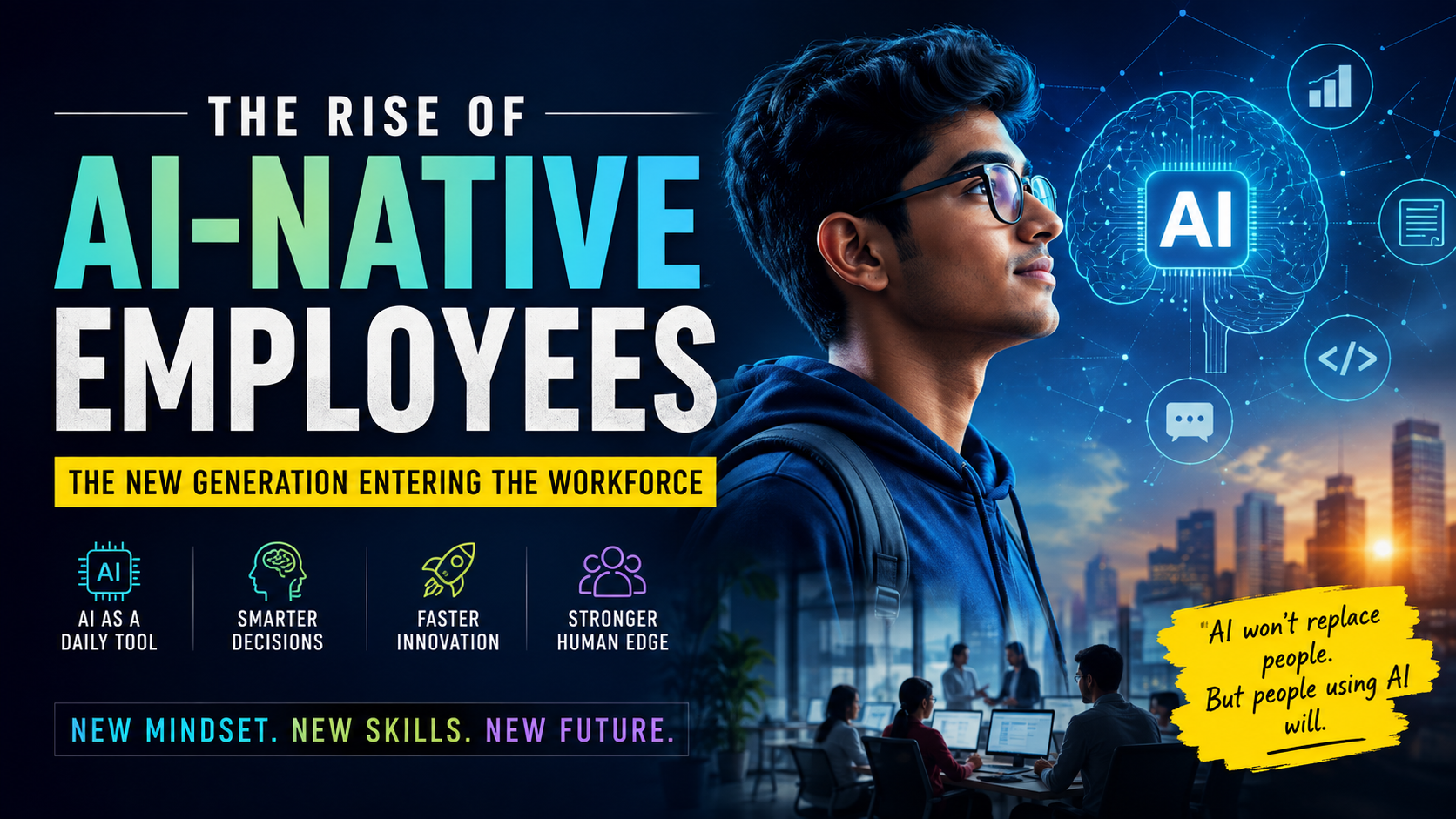
There is a new type of employee entering the workforce.
They are not necessarily AI engineers.
They don't all have advanced degrees in machine learning.
And many of them have never worked in a company before.
What makes them different is something much simpler:
They grew up learning how to work with AI.
For them, AI isn't a futuristic technology. It's already part of how they search for information, learn new skills, write, create, analyze data and solve everyday problems.
This is giving rise to what could become one of the biggest workplace shifts of the next few years:
the AI-native employee.
What Does “AI-Native” Actually Mean?
Being AI-native doesn't simply mean knowing how to use ChatGPT or another AI tool.
It's about developing a different way of working.
An AI-native employee might use AI to:
Research a new topic in minutes
Analyze large amounts of information
Create a first draft of a report
Write and debug code
Automate repetitive tasks
Generate ideas
Summarize meetings and documents
Build prototypes quickly
Learn unfamiliar tools faster
But the most important skill isn't prompting an AI tool.
It's knowing what to ask, what to trust and what to verify.
That is where the real advantage comes from.
AI Is Becoming a Work Skill, Not Just a Technical Skill
For a long time, technology skills were mostly associated with technical roles.
Developers wrote code.
Data analysts worked with data.
Designers used design software.
Marketers used analytics platforms.
AI is different.
It is becoming useful across almost every department.
A recruiter can use AI to improve sourcing and candidate screening.
A marketer can use it for research and content development.
A salesperson can use it to prepare for customer conversations.
An HR professional can use it to analyze employee feedback.
A finance professional can use it to identify patterns in large datasets.
This means AI literacy could eventually become as common as knowing how to use spreadsheets or email.
The Biggest Advantage: Speed
Imagine two employees receive the same assignment.
One spends three hours researching the topic, organizing information and preparing a first draft.
The other uses AI to accelerate the research, structure the information and generate an initial version — then spends the saved time reviewing, improving and adding their own expertise.
The second employee isn't necessarily working less.
They are working differently.
And that's the real promise of AI in the workplace:
Not replacing human effort, but increasing the amount of meaningful work one person can accomplish.
But AI-Native Doesn't Mean AI-Dependent
This distinction is extremely important.
There is a difference between:
“AI can do this for me.”
and
“I know how to use AI to do this better.”
The first can create dependency.
The second creates leverage.
Employees who blindly accept AI-generated answers can make mistakes faster.
Employees who understand the subject, question the output and verify important information can use AI as a productivity multiplier.
The future workplace will therefore need two things at the same time:
AI skills + human judgment.
Critical Thinking May Become More Valuable
This sounds almost ironic.
As AI becomes better at generating answers, knowing the answer may become less valuable.
Knowing whether the answer is correct may become more valuable.
Employees will increasingly need to ask:
Is this information accurate?
What assumptions is the AI making?
What data is missing?
Does this recommendation make business sense?
What could go wrong?
What should a human decide instead?
AI can generate possibilities.
Humans still need to make decisions.
The Resume Is Changing Too
Traditional resumes often focus on qualifications:
Degree.
Certification.
Years of experience.
Technical skills.
But employers may increasingly want to know something else:
What can you actually accomplish with modern tools?
A candidate who says:
“I know AI.”
doesn't say much.
A candidate who says:
“I built an AI-powered workflow that reduced a repetitive process from two hours to twenty minutes.”
tells a very different story.
This is why portfolios, projects and measurable outcomes could become increasingly important.
AI-Native Freshers Could Have an Interesting Advantage
Fresh graduates often face one major problem:
They don't have years of experience.
But AI can help reduce the gap in certain areas.
A motivated fresher can use AI to learn unfamiliar technologies faster, build projects, analyze data, improve communication and experiment with ideas that previously required much more time.
That doesn't replace experience.
But it can accelerate learning.
And companies may increasingly value candidates who demonstrate that ability.
Companies Will Have to Adapt Too
This change isn't only about employees.
Organizations will also need to rethink how they work.
If employees can automate repetitive tasks, companies should ask:
Why are we still making people do them manually?
If AI can help teams analyze information faster, workflows need to change.
If employees can build prototypes in hours instead of weeks, product development processes may need to become more flexible.
The organizations that benefit most from AI may not simply be the ones buying the best AI tools.
They may be the ones redesigning their workflows around them.
The Human Skills Aren't Going Away
There is one misconception worth clearing up.
An AI-native workplace does not mean a workplace without human skills.
Communication will still matter.
Leadership will still matter.
Creativity will still matter.
Empathy will still matter.
Problem-solving will still matter.
In fact, these skills could become even more valuable.
When everyone has access to powerful AI tools, the competitive advantage may shift from who can produce more to who can think better about what should be produced.
What Should Students and Young Professionals Do Now?
Don't try to learn every AI tool that appears online.
Tools will change.
The fundamentals won't.
Focus on five things:
1. Learn how AI works
You don't need to become a machine learning researcher, but understand the basics.
2. Learn how to use AI effectively
Practice prompting, research, analysis, automation and AI-assisted workflows.
3. Build real projects
Don't stop at certificates. Create something people can actually use.
4. Develop strong domain knowledge
AI + marketing is powerful.
AI + finance is powerful.
AI + healthcare is powerful.
AI + engineering is powerful.
The combination is where the opportunity lies.
5. Keep your human edge
Communication, judgment, creativity and decision-making will continue to separate good professionals from great ones.
The Workplace Is Entering a New Phase
The previous generation learned to work with computers.
Then came the internet.
Then smartphones and cloud technology changed how we communicated and collaborated.
Now AI is becoming part of the way people actually think and work.
The next generation entering the workforce won't simply ask:
“What software should I learn?”
They may ask:
“How can I use AI to do this better?”
That's a significant shift.
And companies that recognize it early could have a major advantage in attracting and developing the next generation of talent.
The future may not belong to employees who know the most about AI.
It may belong to employees who know when to use it, how to use it, and when not to use it.
That is what being AI-native could really mean.
Did you find this helpful?