10 Signs Your Business Is Ready for Cloud Migration (Even If You Don't Realize It Yet) | Savishty
Every business owner remembers the early days.
A small team.
A handful of customers.
One server tucked away in a corner or a simple hosting plan that "worked just fine."
Back then, technology wasn't something you thought about every day.
It simply did its job.
But businesses don't stay the same.
Customers increase.
Teams grow.
Applications become more demanding.
Data multiplies.
And suddenly, the systems that once felt reliable begin showing their age.
Not with a dramatic crash.
But with little frustrations that slowly become part of everyday work.
A slower application here.
An unexpected outage there.
A storage upgrade that takes weeks.
An IT team constantly putting out fires instead of building new ideas.
These are often the first signs that your business has outgrown traditional infrastructure.
What Is Cloud Migration?
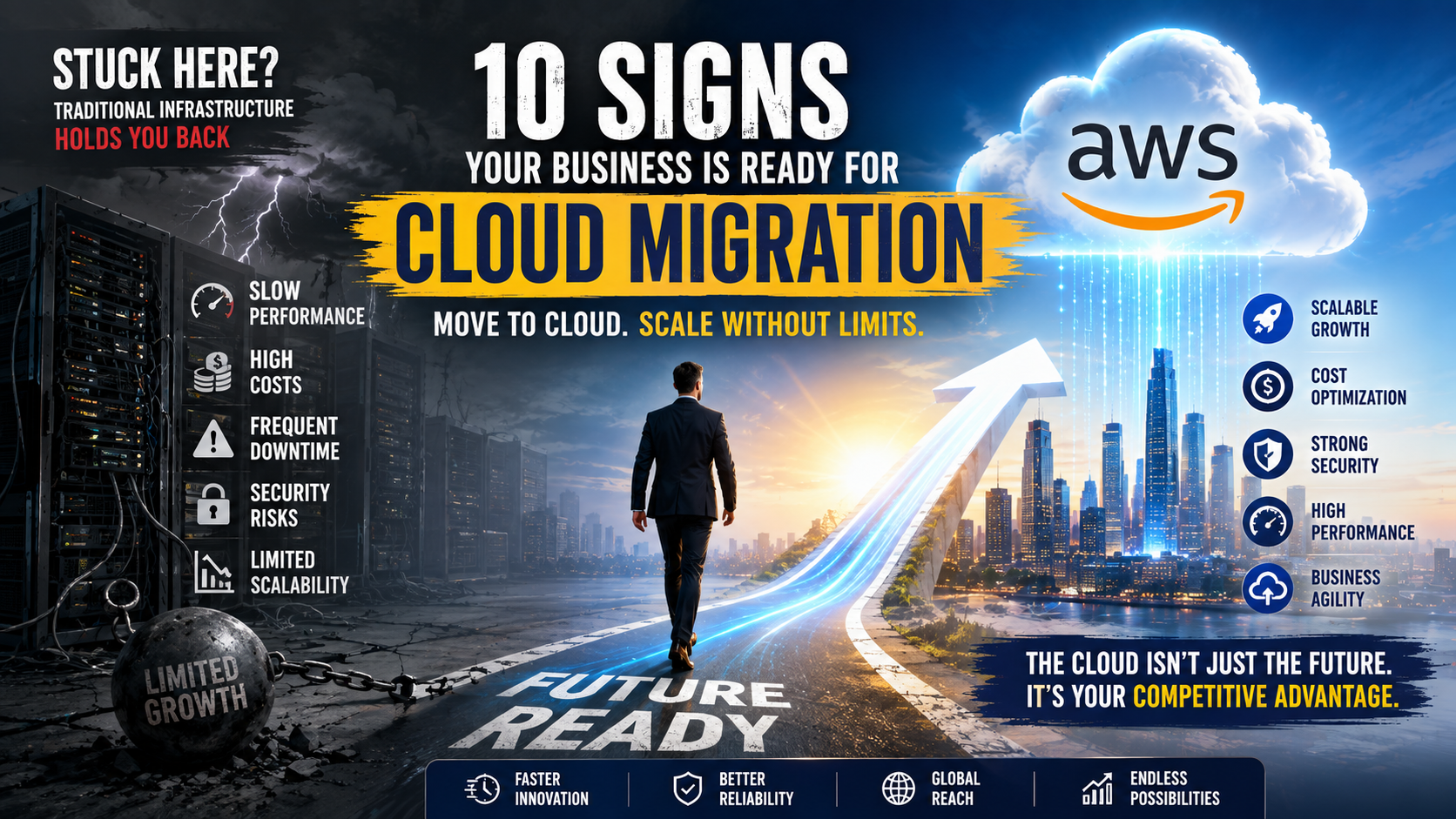
Cloud migration is the process of moving your applications, databases, files, and workloads from traditional on-premise servers or basic hosting to a cloud platform like Amazon Web Services (AWS).
It's not about following a trend.
It's about giving your business the flexibility to grow without technology becoming a bottleneck.
The question isn't "Should we move?"
It's "Are we already at the point where staying the same is costing us more?"
Let's find out.
1. Your Website Slows Down During Busy Hours
Traffic should be exciting.
Instead, it makes your team nervous.
If your website struggles during sales campaigns, festive seasons, or product launches, your infrastructure isn't scaling with your business.
Cloud platforms automatically adjust resources based on demand, helping you maintain performance when it matters most.
2. Your IT Team Spends More Time Fixing Problems Than Building Solutions
If every week starts with server issues, storage upgrades, or emergency maintenance, something isn't right.
Technology should support innovation—not consume it.
Cloud migration frees your technical teams to focus on improving products instead of maintaining hardware.
3. Your Infrastructure Costs Keep Growing
Buying servers.
Replacing hardware.
Maintaining equipment.
Renewing licenses.
Cooling systems.
Power consumption.
These expenses add up quickly.
Cloud computing shifts infrastructure from large upfront investments to a flexible pay-as-you-go model, helping businesses optimize costs while scaling as needed.
4. Your Employees Work From Different Locations
Hybrid work isn't a temporary trend anymore.
Teams expect secure access to business applications from anywhere.
Cloud infrastructure makes collaboration easier while keeping business data protected through secure access controls.
5. Data Storage Is Becoming a Constant Problem
Every month someone says,
"We're running out of storage again."
If expanding storage feels like a recurring project, cloud storage offers a more scalable approach.
Instead of planning years ahead, you simply use what you need.
6. Downtime Is Becoming Too Expensive
A few years ago, one hour of downtime might have been inconvenient.
Today, it can mean:
Lost sales
Unhappy customers
Missed opportunities
Damaged reputation
Modern businesses can't afford prolonged outages.
Cloud infrastructure is designed for high availability and business continuity.
7. Security Is Keeping You Awake at Night
Cybersecurity threats continue to evolve.
Customers expect their information to remain protected.
Cloud providers invest heavily in advanced security technologies, encryption, monitoring, and compliance features that many businesses would struggle to implement on their own.
8. You're Planning to Launch New Products
Growth often exposes infrastructure limitations.
Launching a mobile app.
Opening an online store.
Expanding into new regions.
Adding AI capabilities.
All of these become significantly easier when your infrastructure is designed to scale from day one.
9. Your Business Relies More on Data Than Ever Before
Every customer interaction creates valuable information.
Sales.
Marketing.
Operations.
Support.
Analytics.
Cloud platforms make it easier to store, process, and analyze this data, helping leaders make faster and more informed decisions.
10. Your Competitors Are Moving Faster
Perhaps the biggest sign isn't inside your business.
It's outside.
Competitors launch features more quickly.
Roll out updates faster.
Enter new markets sooner.
Respond to customer needs almost instantly.
While many factors contribute to that speed, modern cloud infrastructure often plays a major role.
Businesses that remove technology bottlenecks can focus on what really matters—innovation.
Cloud Migration Isn't Just About Technology
Many people think cloud migration is an IT project.
In reality, it's a business decision.
It affects customer experience.
Employee productivity.
Business continuity.
Cost management.
Future growth.
Technology should enable your business not limit it.
How AWS Makes Cloud Migration Easier
AWS provides businesses with a broad range of services designed to simplify migration and long-term operations.
Some of the most widely used include:
Amazon EC2 for scalable computing.
Amazon S3 for secure and reliable storage.
Amazon RDS for managed databases.
AWS Migration Hub for tracking migration progress.
AWS Backup for automated recovery.
Amazon CloudWatch for monitoring system performance.
Together, these services help organizations migrate confidently while minimizing disruption.
Final Thoughts
Not every business needs to migrate tomorrow.
But every business should regularly ask one important question:
Is our technology helping us grow or quietly holding us back?
If several of the signs in this article sound familiar, it may be time to explore what cloud migration could do for your business.
Because the businesses that succeed over the next decade won't necessarily have the biggest budgets.
They'll be the ones with the flexibility to adapt, scale, and innovate without being held back by yesterday's infrastructure.
Frequently Asked Questions
What is cloud migration?
Cloud migration is the process of moving applications, databases, files, and IT worklioads from on-premise infrastructure to cloud platforms such as AWS.
Is cloud migration only for large enterprises?
No. Startups, small businesses, and mid-sized organizations also benefit from lower costs, improved scalability, and better security.
How long does cloud migration take?
The timeline depends on your infrastructure, applications, and business requirements. Some migrations take a few weeks, while larger enterprise projects can take several months.
What are the biggest benefits of cloud migration?
The key benefits include lower infrastructure costs, automatic scalability, stronger security, improved disaster recovery, faster deployment, and greater flexibility for business growth.while larger enterprise projects can take several months.
What are the biggest benefits of cloud migration?
The key benefits include lower infrastructure costs, automatic scalability, stronger security, improved disaster recovery, faster deployment, and greater flexibility for business growth.
Did you find this helpful?