AI's Biggest Revolution Is Still Ahead: Why Anthropic's CEO Thinks We're Only Scratching the Surface | Savishty
Here's a humanized, engaging blog that feels natural and is optimized for readers rather than sounding AI-generated.
Writing
AI's Biggest Revolution Is Still Ahead: Why Anthropic's CEO Thinks We're Only Scratching the Surface
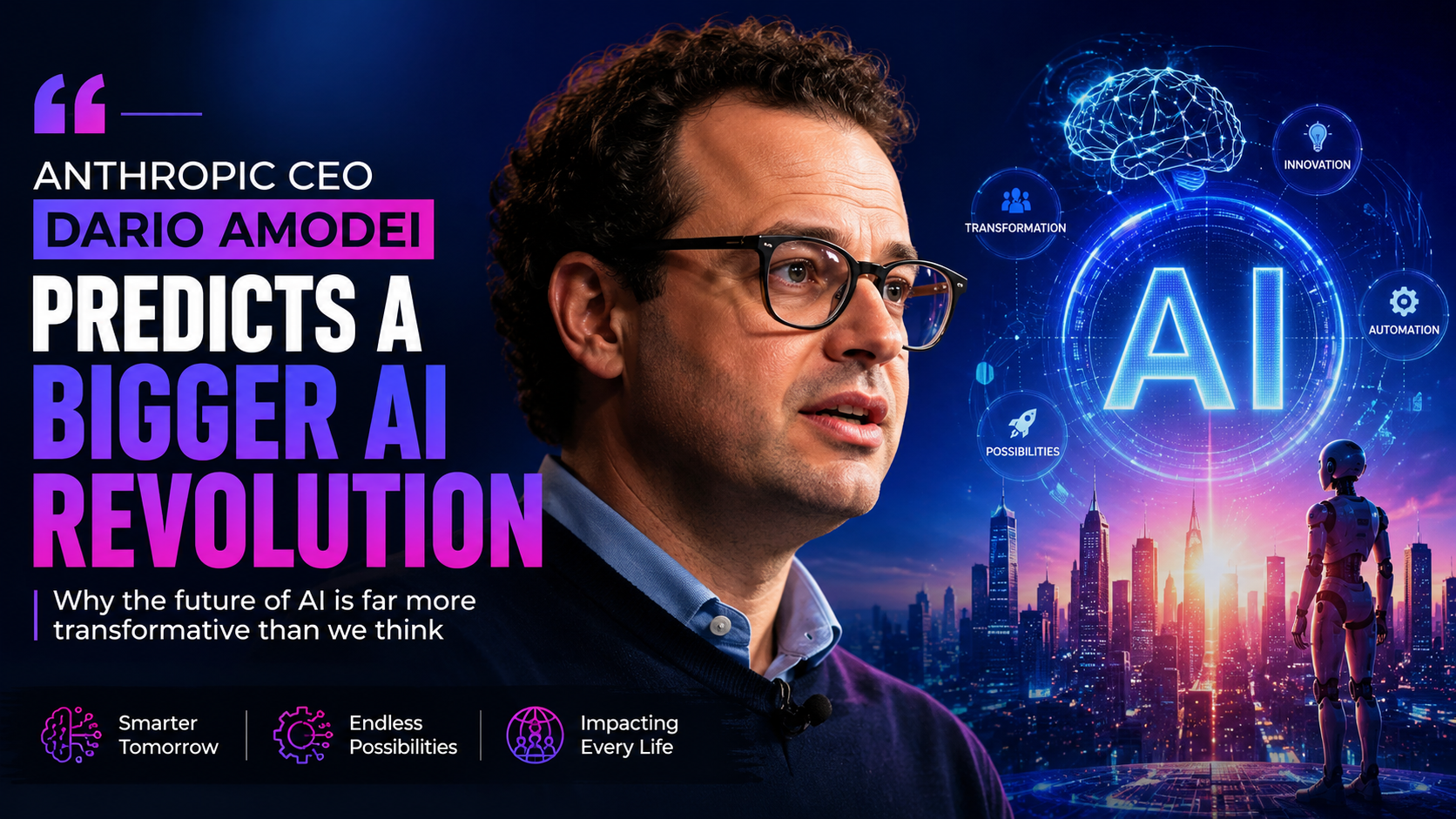
For years, artificial intelligence has been at the center of headlines. We've seen AI write code, generate videos, assist doctors, and even help students prepare for exams. Yet according to Anthropic CEO Dario Amodei, we're still underestimating what AI is truly capable of becoming.
For years, artificial intelligence has been at the center of headlines. We've seen AI write code, generate videos, assist doctors, and even help students prepare for exams. Yet according to Anthropic CEO Dario Amodei, we're still underestimating what AI is truly capable of becoming.
That's a bold statement especially at a time when many people already believe AI is advancing faster than society can keep up. But Amodei argues that history has a habit of repeating itself. Just as the internet, smartphones, and cloud computing were initially underestimated, AI may be on the verge of an even more profound transformation.
Why This Matters
Most conversations about AI today revolve around chatbots and productivity tools. While these applications are impressive, they represent only the first chapter of a much larger story.
The next wave of AI isn't just about answering questions faster. It's about helping scientists discover new medicines, enabling engineers to design better products, assisting businesses in making smarter decisions, and allowing individuals to automate complex tasks that once required specialized expertise.
If these capabilities continue to improve at their current pace, AI could become as essential as electricity or the internet—something woven into nearly every aspect of daily life.
The Opportunity Is Bigger Than We Think
Imagine a future where:
Medical researchers use AI to accelerate life-saving discoveries.
Small businesses access enterprise-level intelligence without massive budgets.
Developers build software in days instead of months.
Teachers create personalized learning experiences for every student.
Entrepreneurs launch global businesses with AI handling operations, marketing, and customer support.
These possibilities are no longer science fiction. Many of them are already beginning to take shape.
But There's Another Side to the Story
Every technological revolution creates both opportunities and challenges.
As AI becomes more capable, questions around job displacement, misinformation, security, privacy, and regulation become increasingly important. The challenge isn't simply building more powerful AI—it's ensuring that it's developed responsibly and benefits society as a whole.
This is why companies like Anthropic continue to emphasize AI safety alongside innovation. The goal is not only to make AI smarter but also more reliable, transparent, and aligned with human values.
What Businesses Should Do Today
Organizations that wait for AI to become "perfect" may find themselves falling behind.
Instead, businesses should focus on:
Identifying repetitive workflows that AI can automate.
Upskilling employees to work alongside AI tools.
Experimenting with AI-powered customer service, marketing, and analytics.
Building governance frameworks for responsible AI adoption.
The companies that learn how to combine human creativity with AI capabilities will likely gain a significant competitive advantage over the coming years.
Final Thoughts
Dario Amodei's message isn't simply that AI will become more powerful it's that we're still thinking too small.
The biggest impact of AI may not come from replacing people, but from amplifying what people can accomplish. Just as previous technological revolutions reshaped industries and created entirely new opportunities, AI has the potential to redefine how we work, innovate, and solve some of humanity's biggest challenges.
Whether that future becomes empowering or disruptive depends on the choices we make today.
One thing is becoming increasingly clear: the AI revolution isn't slowing down. In many ways, it's only just beginning.
Did you find this helpful?