Fresher Salaries Are Rising in India But There’s a Catch | Savishty
Fresher Salaries Are Rising in India — But There’s a Catch
For years, one of the biggest complaints from engineering graduates was simple:
“Companies want experience, but how do you get experience as a fresher?”
The campus hiring market may finally be changing.
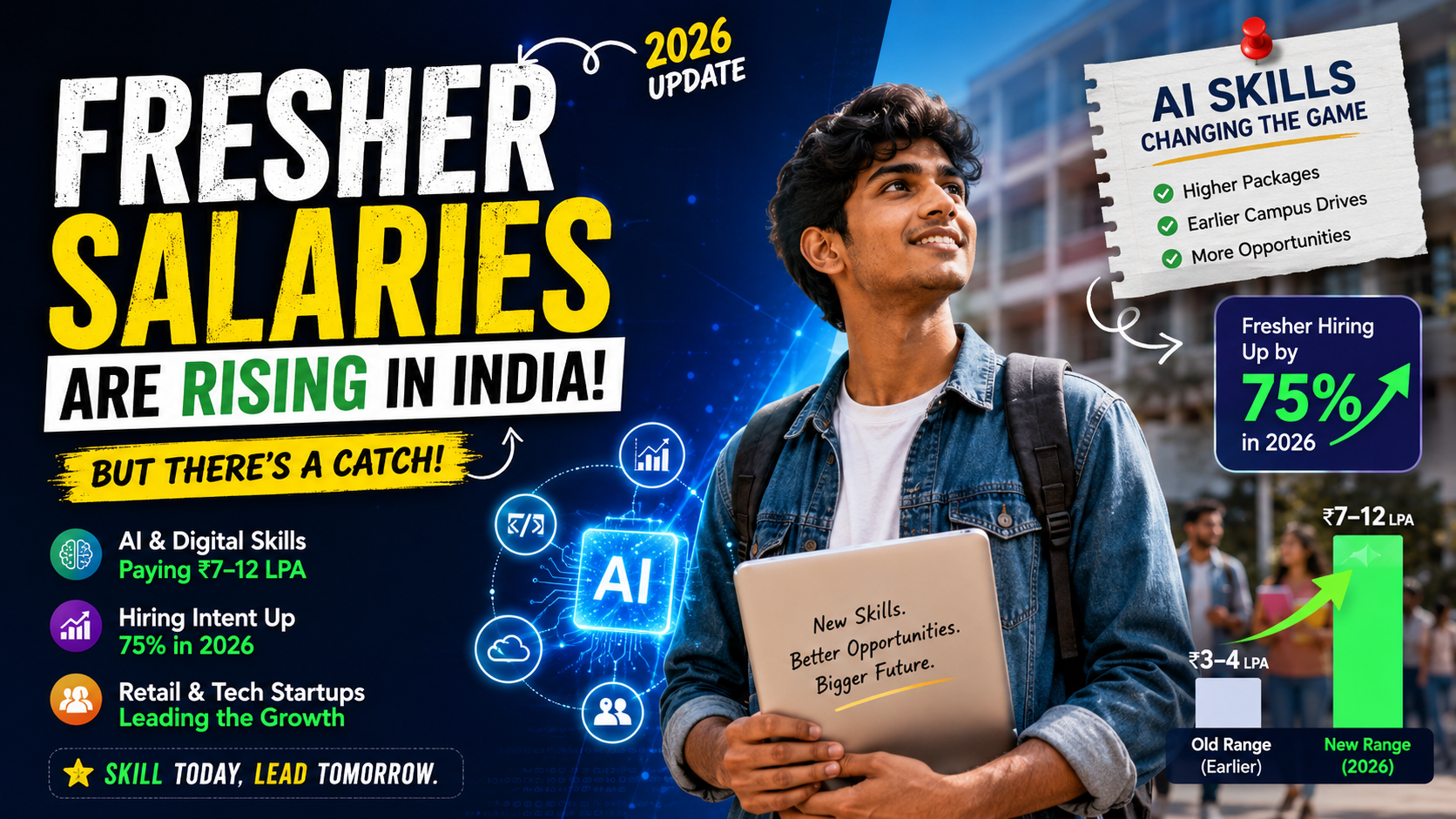
According to the report featured in the LinkedIn News screenshot, fresher salaries at Indian engineering campuses are rising in 2026, with students who have strong AI and digital skills receiving offers in the ₹7–12 lakh range, compared with the older
₹3–4 lakh range for many entry-level roles.
And honestly, this shift says something bigger about where India's IT industry is heading.
AI skills are changing the fresher game
Companies aren't just looking for someone who knows how to write routine code anymore.
They want graduates who can work with AI, understand digital tools, analyse data, automate tasks and solve real business problems.
That changes the equation for freshers.
A student who can combine programming with AI skills may now stand out against someone who only knows the basics of coding.
The message for students is pretty clear:
Your degree gets you into the race. Your skills decide how far you go.
Campus hiring is showing signs of recovery
After a relatively weak hiring environment in 2025, campus recruitment appears to be picking up again.
The report highlights plans by major IT companies such as TCS, Infosys and Cognizant to hire fresh talent, with recruitment potentially reaching 20,000–25,000 freshers.
Even more interesting?
Companies are reportedly starting campus drives earlier.
That could be a positive signal for students who were worried about graduating into a slow job market.
But the recovery isn't equal everywhere
Here's the part students shouldn't ignore.
Hiring isn't growing uniformly across every industry.
According to the data mentioned in the report, retail, e-commerce and technology startups are showing particularly strong hiring intent, at around 93%, followed by manufacturing at 89%.
Meanwhile, some traditional sectors such as IT, consulting and telecom are still showing signs of caution.
So simply saying “IT hiring is back” would be an oversimplification.
The market is becoming more selective.
The ₹7–12 LPA opportunity comes with a new expectation
Higher fresher salaries sound exciting.
But companies aren't suddenly paying more for the same skill set.
They're paying a premium for skills that can create value faster.
Think about the difference:
Old approach:
Learn a programming language → build basic projects → apply everywhere.
New approach:
Learn programming → understand AI → work with data → build practical projects → use automation tools → understand business problems.
That's a much stronger profile.
And this doesn't mean every fresher needs to become an AI researcher.
It means students should understand how AI is changing their own field.
A Java developer should understand AI-assisted development.
A data analyst should understand AI-powered analytics.
A marketer should understand AI automation.
A recruiter should understand AI sourcing and screening.
The skill isn't just AI.
It's AI + your existing domain.
What should students do now?
If you're graduating in 2026 or preparing for campus placements, this is probably not the time to collect 20 certificates.
Instead, focus on three things:
1. Build one strong technical foundation
Python, Java, SQL, cloud, data analytics choose based on your career direction and actually get good at it.
2. Add AI to your skill stack
Learn how AI tools, automation and GenAI can be applied to your field.
3. Build projects that solve real problems
A project that demonstrates how you think is often more valuable than another certificate sitting on your resume.
The bigger picture
India's fresher hiring market isn't simply going back to the way it was before 2025.
It's evolving.
The entry-level job is changing from:
“Can you code?”
to:
“Can you use technology to solve problems?”
And that difference matters.
For students, this could actually be a great opportunity.
But the students who benefit most won't necessarily be the ones with the highest number of certificates.
They'll be the ones who adapt fastest.
Because in 2026, being a fresher doesn't mean having zero value.
It means showing employers how quickly you can create value.
The campus hiring game is changing. The question is: are students changing with it?
Did you find this helpful?