From Chatbots to Predictive Analytics: AI Applications Built on AWS | Savishty
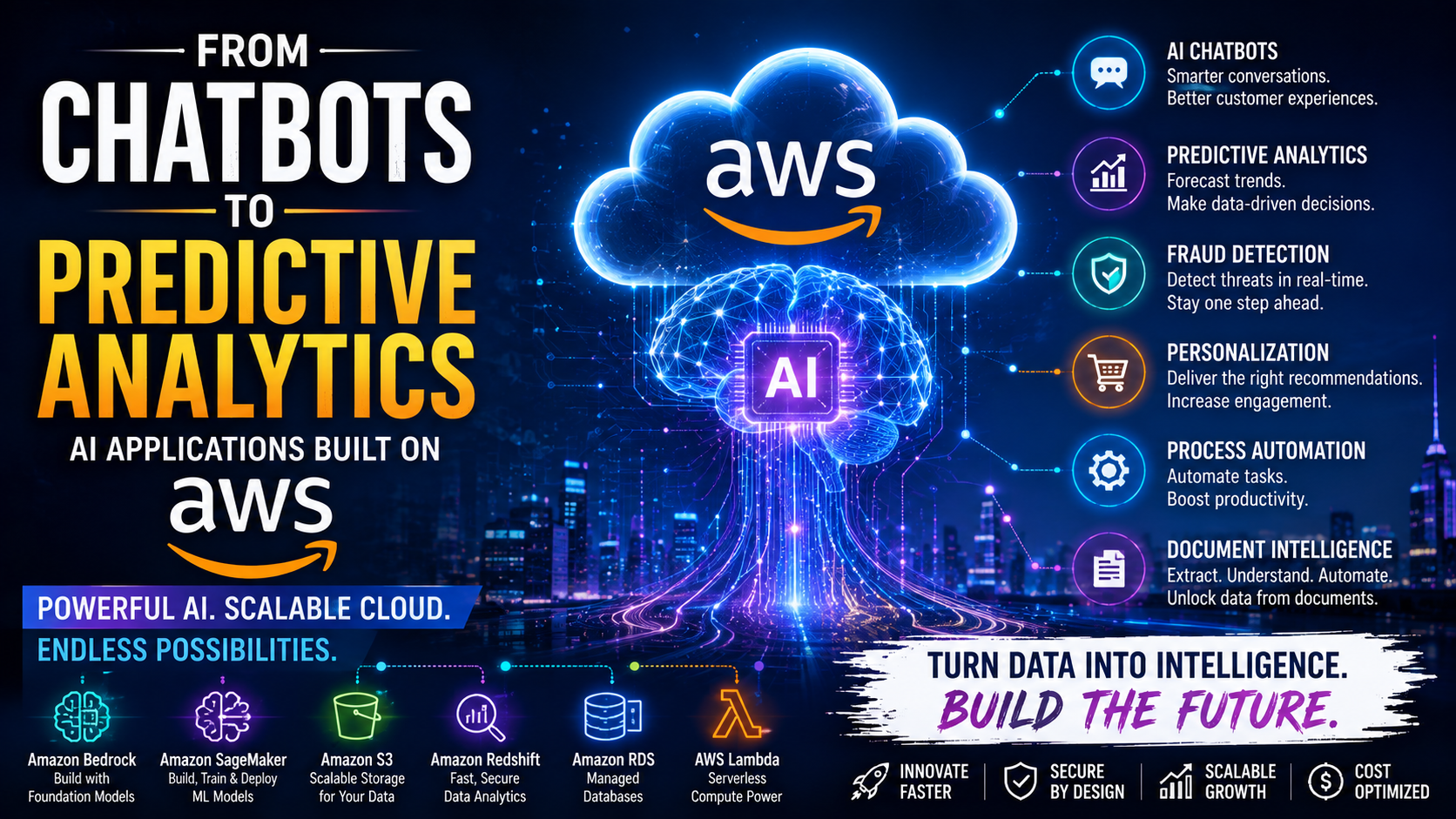
AI Has Moved Beyond the Chatbot.
A customer asks a chatbot, “Where is my order?
The answer arrives instantly.
Useful? Absolutely.
But that's only the beginning.
The more interesting question is what happens before the customer even asks.
Can AI predict that the customer is likely to cancel an order?
Can it identify unusual payment activity?
Can it recommend the right product?
Can it forecast next month's demand?
Can it help a business make decisions before a problem becomes obvious?
This is where AI on AWS gets really interesting.
Cloud computing gave businesses the infrastructure to scale. AI is now giving that infrastructure the ability to learn from data, recognize patterns, and support better decisions.
Why AWS Is Becoming a Major Platform for AI
Building an AI application isn't simply about choosing a machine learning model.
You also need computing power, storage, databases, security, data pipelines, monitoring, and the ability to scale.
That's where AWS comes in.
AWS provides a broad ecosystem of cloud and AI services that businesses can combine to build everything from simple intelligent applications to sophisticated machine learning platforms.
And the best part?
A startup doesn't necessarily need the infrastructure budget of a large enterprise to experiment with AI.
1. AI-Powered Chatbots
Let's start with the application everyone knows.
Chatbots.
But modern AI chatbots are very different from the old rule-based bots that responded with:
"Sorry, I didn't understand your question."
Businesses can now build conversational systems that understand natural language and assist customers with everything from product questions to technical support.
With AWS services such as Amazon Bedrock, organizations can build generative AI applications using foundation models without having to build and manage those models from scratch.
Imagine a customer support assistant that can:
Understand natural language
Search company knowledge
Answer product questions
Summarize conversations
Assist support agents
Generate personalized responses
That's no longer a futuristic idea.
It's becoming part of everyday business operations.
2. Predictive Analytics: Knowing What Might Happen Next
This is where AI becomes much more valuable to business leaders.
Traditional analytics tells you:
"What happened?"
Predictive analytics asks:
"What is likely to happen next?"
For example:
A retailer can predict which products will be in demand.
A bank can identify transactions that look suspicious.
A manufacturer can predict when equipment may require maintenance.
A subscription company can identify customers who may be preparing to leave.
The goal isn't to predict the future perfectly.
It's to make better decisions with the information you already have.
AWS provides machine learning and analytics services that can help organizations build these predictive capabilities at scale.
3. Fraud Detection
Fraud doesn't always look obvious.
One transaction might appear completely normal.
But when thousands of transactions are analyzed together, patterns begin to emerge.
AI can help identify unusual behavior based on factors such as transaction history, location, spending patterns, device information, and other signals.
This can be particularly valuable for:
Banks
E-commerce companies
Fintech platforms
Insurance companies
Payment providers
Instead of investigating every transaction manually, businesses can use AI to identify transactions that deserve closer attention.
4. Personalized Customer Experiences
Remember the last time an online store seemed to know exactly what you wanted?
That's data and AI working together.
AI can analyze customer behavior and help businesses personalize:
Products.
Content.
Offers.
Recommendations.
Marketing messages.
For an e-commerce company, that could mean recommending products based on browsing and purchasing behavior.
For a streaming platform, it could mean suggesting what someone might want to watch next.
Personalization isn't just about making customers feel understood.
It can directly influence engagement and conversions.
5. Predictive Maintenance
Imagine a factory with hundreds of machines.
Waiting for a machine to break is expensive.
Production stops.
Orders get delayed.
Engineers rush to diagnose the problem.
AI offers another approach.
By analyzing sensor data and historical machine behavior, organizations can identify patterns that may indicate an upcoming failure.
Instead of asking:
"Why did the machine stop?"
the business can start asking:
"Does the data suggest this machine is likely to fail soon?"
That shift from reactive maintenance to predictive maintenance can have a major impact on industrial businesses.
6. AI-Powered Document Processing
Businesses deal with enormous amounts of documents every day.
Invoices.
Contracts.
Forms.
Receipts.
Applications.
Reports.
Manually extracting information from them is slow and repetitive.
AWS AI services such as Amazon Textract can help organizations extract text and structured information from documents.
This opens the door to automation across industries such as banking, insurance, healthcare, logistics, and finance.
Instead of employees spending hours copying information from documents, AI can handle much of the repetitive work.
People can then focus on decisions that actually require human judgment.
7. Smarter Data Analysis
Businesses already have enormous amounts of data.
The problem is often knowing what to do with it.
Sales data.
Customer data.
Website activity.
Operational data.
Financial information.
AI can help teams find patterns that aren't immediately obvious.
When AI is combined with cloud data platforms, organizations can move from simply collecting data to actually learning from it.
And that's a major difference.
Data sitting in a database has limited value.
Data that improves a decision has business value.
8. Generative AI for Employees
AI isn't only changing customer experiences.
It's changing how employees work.
Teams can use generative AI to:
Summarize long documents
Draft emails
Generate reports
Search internal knowledge
Analyze information
Write and review code
Create content
Automate repetitive tasks
With AWS services such as Amazon Bedrock, businesses can explore generative AI while keeping their applications connected to their existing cloud environment.
The real opportunity isn't replacing every employee.
It's removing the repetitive work that prevents employees from doing their best work.
The Bigger Picture: AI + Cloud
AI needs data.
AI needs computing power.
AI needs storage.
AI needs security.
AI needs scalability.
That's why cloud and AI are becoming so closely connected.
The cloud provides the foundation.
AI provides the intelligence.
Together, they allow businesses to experiment faster, deploy applications more easily, and scale successful ideas without rebuilding their infrastructure from scratch.
But AI Isn't Magic
There's an important reality businesses shouldn't ignore.
Buying an AI service doesn't automatically create an AI strategy.
Poor-quality data can produce poor results.
Weak security can create new risks.
Unclear business objectives can turn an expensive AI project into a technology experiment with no measurable value.
The best AI projects usually start with a simple question:
"What business problem are we trying to solve?"
Not:
"Where can we use AI?"
That's an important difference.
What's Next?
The next generation of business applications won't simply be cloud-based.
They'll be increasingly AI-powered, data-driven, and automated.
Customer service will become more intelligent.
Forecasting will become more accurate.
Employees will have AI assistants.
Operations will become more predictive.
And businesses will increasingly use real-time data to make decisions.
The companies that benefit most won't necessarily be the ones that use the most AI.
They'll be the ones that use it where it actually matters.
Final Thoughts
The journey from chatbots to predictive analytics is really a journey from AI that responds to AI that helps businesses anticipate and act.
AWS gives organizations the cloud infrastructure and AI services needed to explore that journey—from generative AI and intelligent assistants to machine learning, analytics, automation, and predictive applications.
The question isn't whether AI will become part of business.
It already is.
The bigger question is:
What will your business build with it?
SEO Keywords
AI on AWS, AWS AI Services, AWS Machine Learning, Amazon Bedrock, Predictive Analytics, Generative AI, Cloud AI, AI Applications, AWS Cloud Computing, Machine Learning on AWS, AI Automation, AI Solutions for Business
Did you find this helpful?