India’s IT Hiring Market Is Waking Up But Hiring Is Not Going Back to the Old Normal | Savishty
India’s IT Hiring Market Is Waking Up — But Hiring Is Not Going Back to the Old Normal
For a long time, the Indian IT hiring market has been in a strange phase.
Jobs were still there, but companies were cautious. Hiring plans were getting pushed. Freshers were finding it harder to get their first opportunity, while experienced professionals were often going through longer interview processes than before.
Now, there are signs that the market is beginning to move again.
But there’s something different about this recovery.
Companies are hiring, but they are hiring with a much clearer idea of what they need.
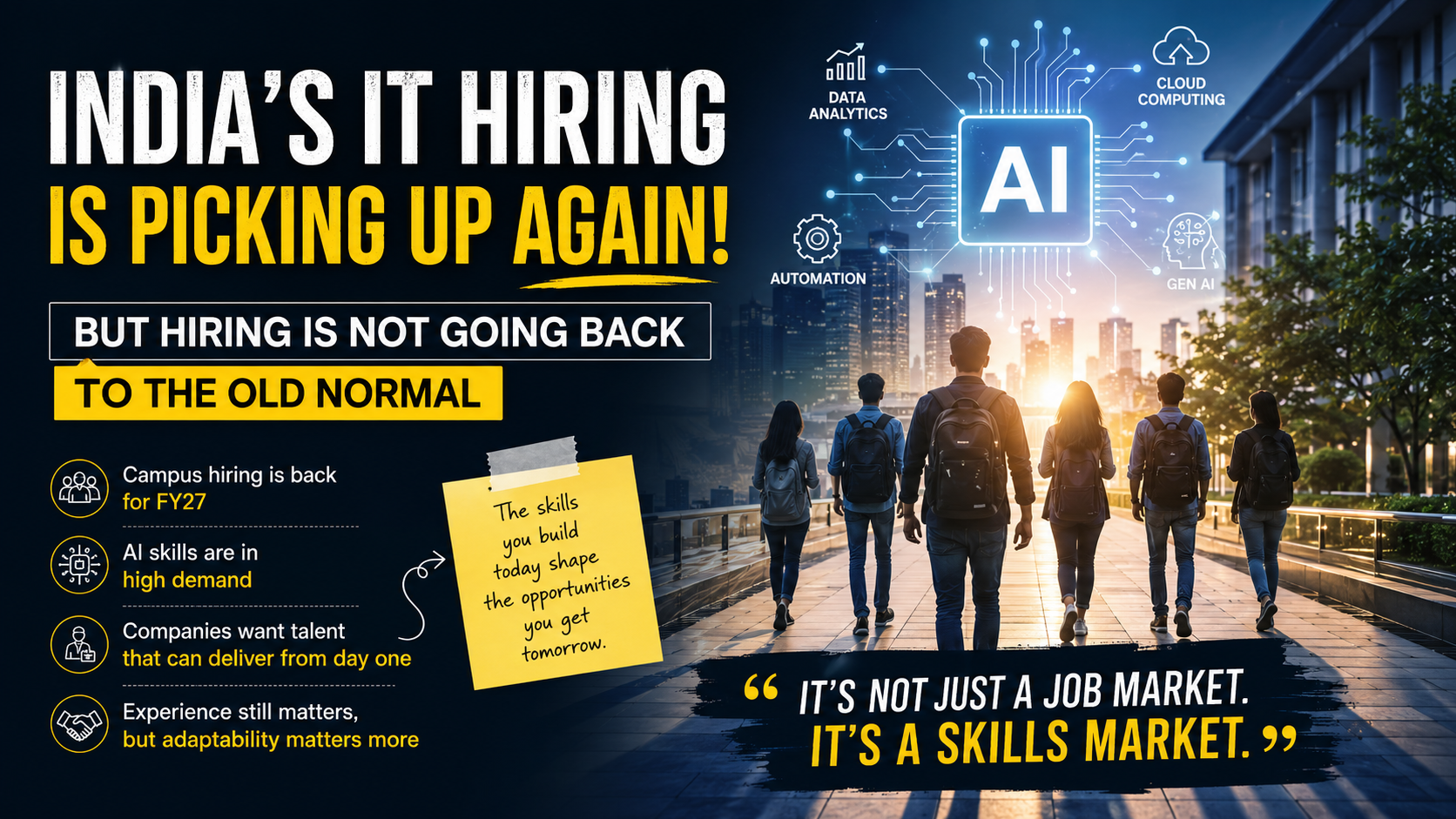
Recent reports suggest that companies including TCS, Infosys, HCLTech and Tech Mahindra are increasing campus hiring for FY27 as demand for AI-related skills continues to grow.
That sounds like excellent news for students.
And it is.
But there is a little more to the story.
The “any graduate will do” approach is changing
A few years ago, campus hiring often worked on a simple model.
Hire a large batch of graduates → train them → place them into projects.
Today, companies are under more pressure to show productivity and manage costs. So naturally, they want people who can become productive faster.
That doesn't necessarily mean every fresher needs to be an AI expert.
It does mean that a candidate who has spent time actually working with technology will probably have an advantage.
For example, there is a big difference between saying:
“I know Python and machine learning.”
and saying:
“I built a small recommendation system using Python, worked with real data, faced these problems and solved them this way.”
The second person gives a recruiter something to work with.
That is where the idea of job-ready talent is becoming increasingly important.
And then there is AI
AI has added another layer to an already changing hiring market.
Companies aren't only hiring people to perform tasks that can be automated easily. They increasingly need people who understand how to use AI to work faster, analyse information, build products and solve business problems.
This is why skills around AI, data, cloud, automation and software development are getting more attention.
But there is an important point that sometimes gets lost in all the AI hype.
Knowing how to use ChatGPT is not the same as being an AI professional.
Having a few AI tools on your resume won't automatically make you employable.
What matters is whether you understand the fundamentals and can actually use technology to create something useful.
That could be a project, an automation workflow, an AI-powered application, a data solution or even a practical improvement to an existing business process.
The technology will keep changing.
The ability to learn and apply it is what will stay valuable.
Experienced professionals are still very much in the picture
There is another side to the current hiring trend that deserves attention.
While some companies are returning to campus hiring, others are reportedly focusing more on experienced professionals who can be deployed quickly when a project requires them.
And honestly, it makes sense.
A company starting a new project may not always have six months to train someone.
Sometimes they need a person who can join, understand the requirement and start contributing almost immediately.
This is one reason why staffing, contract hiring and workforce augmentation are becoming important parts of the talent strategy for businesses.
Companies want flexibility.
They want access to the right skills without necessarily making every hiring decision a long-term commitment.
So, is this good news for freshers?
I would say yes.
But with a different mindset.
The market isn't necessarily saying:
“Freshers are not wanted.”
It is saying:
“Freshers need to be better prepared.”
A degree can get your resume into the system.
Your skills, projects, communication and ability to solve problems can help get you through the system.
This is why students should probably stop asking only:
“Which certification should I do next?”
A better question would be:
“What can I actually build or solve with what I've learned?”
One solid project that you can confidently explain is often more valuable than five certificates you barely remember studying for.
What about people already working in IT?
The message is slightly different for experienced professionals.
Experience still matters. A lot.
But experience alone may not protect someone from changing technology.
Someone with five years of experience who refuses to learn new tools can eventually find themselves competing with someone with three years of experience who knows how to use AI, automation and modern development practices effectively.
The answer isn't to chase every new technology.
Nobody can.
The smarter approach is to understand where your existing expertise meets the new technology.
A developer can learn AI-assisted development.
A data professional can explore GenAI and automation.
A recruiter can use AI for sourcing and screening while improving human judgement.
A cloud professional can understand AI infrastructure.
That's where the real opportunity is.
The hiring market is becoming more practical
Perhaps the biggest change is this:
Companies are becoming much more focused on outcomes.
Not just:
“Does this candidate have the degree?”
But:
“Can this person solve the problem we have?”
Not just:
“Do they have AI on their resume?”
But:
“Can they actually use AI in their work?”
Not just:
“Do they have five years of experience?”
But:
“Is that experience relevant to what we need right now?”
That's a very different hiring conversation.
And it will probably make recruitment more challenging — but also more meaningful.
What happens next?
I don't think we're going back to the massive hiring numbers of the earlier IT boom overnight.
The market is likely to remain selective.
Companies will continue watching costs, productivity and business demand closely.
But the fact that hiring is starting to pick up is encouraging.
For freshers, it means opportunities are returning but preparation matters.
For experienced professionals, it means staying relevant matters.
For recruiters, it means understanding skills rather than simply matching keywords.
And for companies, it means finding the right balance between building talent for tomorrow and hiring talent that can deliver today.
The IT hiring market isn't dead.
It's changing.
And perhaps the biggest opportunity will go to the people who understand that change early enough to adapt to it.
Did you find this helpful?