Can Your Cloud Application Trust Its Own Internal Network? | Savishty
Can Your Cloud Application Trust Its Own Internal Network?
Your cloud application may be secure from the internet. But what happens when an attacker gets inside?
Many organizations invest heavily in firewalls, VPNs, network segmentation, and perimeter security to protect their cloud infrastructure. But there is one dangerous assumption that still exists in many cloud environments:
If traffic comes from inside the network, it must be safe.
That assumption can turn a small security incident into a major cloud breach.
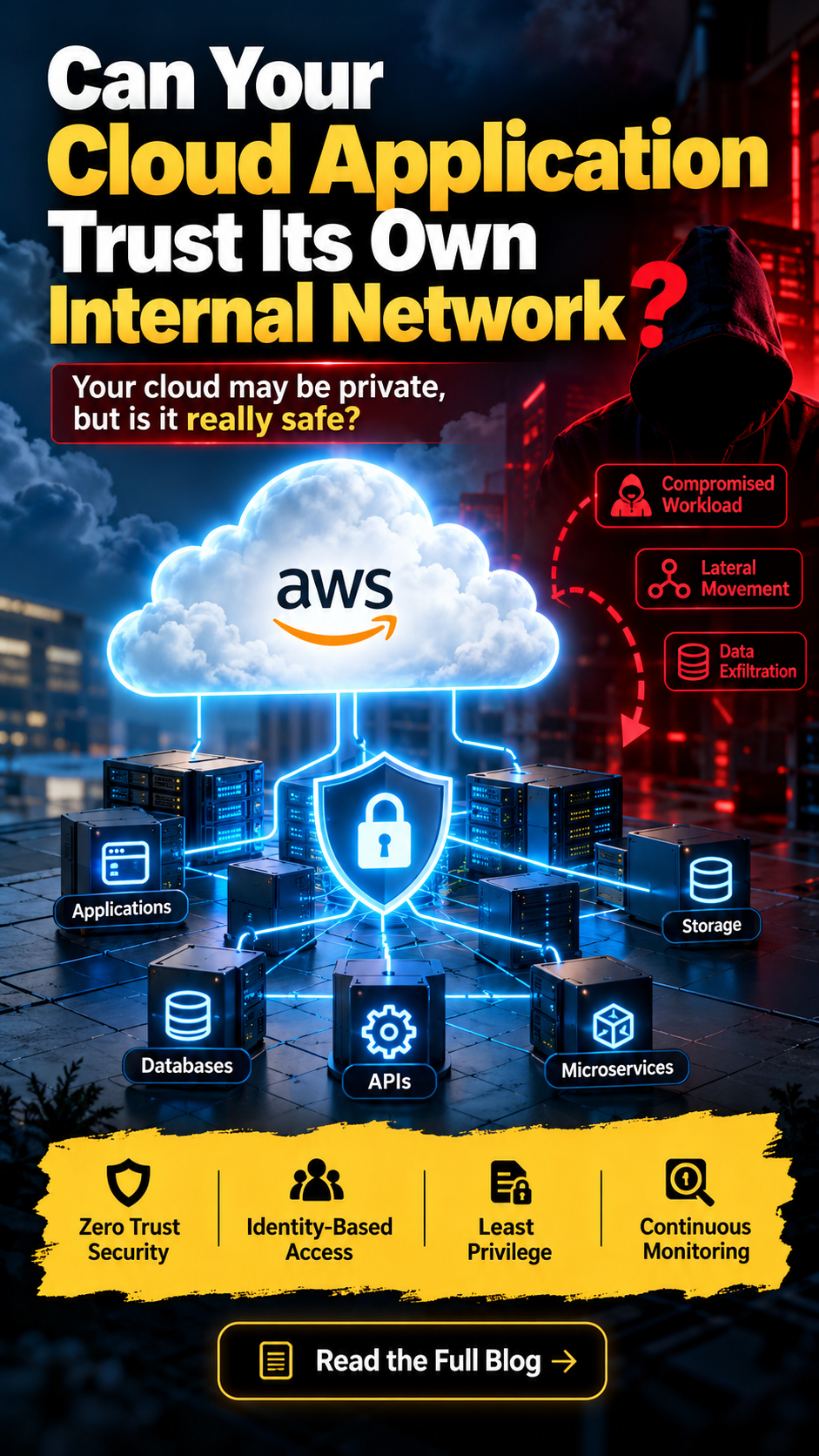
In modern cloud environments, applications communicate constantly with databases, APIs, microservices, storage systems, and third-party services. If these internal connections are trusted automatically, a single compromised workload could give attackers access to much more than they initially targeted.
So, the real question is not whether your cloud network is private.
It is whether your application verifies every connection, even the ones coming from inside.
1. The Hidden Risk of Trusting Internal Traffic
Traditional network security often follows a perimeter-based approach. Traffic coming from outside is considered suspicious, while traffic inside the network receives a higher level of trust.
However, cloud infrastructure changes the security equation.
Applications are distributed across multiple services, containers, virtual machines, APIs, and cloud accounts. These components may communicate across private subnets, virtual networks, and service endpoints.
If an attacker compromises one component, they may attempt to use its network access to reach other internal resources.
For example:
- A vulnerable web application becomes an entry point.
- The attacker discovers an internal API.
- The API accepts requests without sufficient authentication.
- The attacker accesses sensitive customer information or attempts to reach a database.
The internal network has not necessarily been breached at every layer. The problem may be that individual services trusted traffic they should have verified.
2. How Attackers Exploit Implicit Trust
Consider a typical cloud application architecture:
Internet → Load Balancer → Application Service → Internal API → Database
Each component should have its own security controls. But if the application service can freely access internal APIs, and those APIs trust requests based only on their network location, the architecture creates an opportunity for lateral movement.
An attacker who compromises the application service may inherit its legitimate network access.
Potential consequences include:
- Lateral movement: Moving from one compromised workload to other systems.
- Unauthorized API access: Calling internal endpoints without proper identity verification.
- Credential abuse: Exploiting exposed secrets or overly permissive service roles.
- Data exposure: Accessing databases or storage systems beyond the original application's needs.
- Privilege escalation: Using excessive permissions to gain access to more sensitive resources.
The key lesson is simple: private connectivity reduces exposure, but it does not automatically establish trust.
3. Why Private Cloud Networks Are Not Enough
Cloud providers offer powerful network security features. AWS security groups, network ACLs, private subnets, VPC endpoints, and similar controls in other cloud platforms help restrict connectivity.
But network reachability and application authorization solve different problems.
A network rule may allow Service A to communicate with Service B. It does not prove that Service A should access every operation or data set exposed by Service B.
For example, an internal reporting service may legitimately need read access to selected records. Giving it unrestricted database access simply because it resides in the same VPC introduces unnecessary risk.
Effective security requires multiple layers:
- Network controls determine which connections are possible.
- Authentication verifies the identity of a user, workload, or service.
- Authorization determines what that identity is allowed to do.
- Encryption protects data while it moves between components.
- Monitoring helps identify unusual access and suspicious behavior.
No single layer replaces the others.
4. Zero Trust: Verify Every Connection
Zero Trust security is based on a principle that is especially important in cloud-native environments:
Never grant trust solely because a request originates from an internal network.
Instead, each request should be evaluated according to identity, permissions, context, and applicable security policies.
A practical Zero Trust approach includes:
Identity-based access: Give every workload a verifiable identity rather than relying only on IP addresses or subnet membership.
Least-privilege permissions: Allow services to access only the resources and operations they actually require.
Mutual TLS (mTLS): Where appropriate, authenticate both sides of a service connection and encrypt traffic in transit.
Short-lived credentials: Prefer temporary credentials and workload identity mechanisms over long-lived access keys embedded in applications.
Continuous verification: Review authorization and access decisions throughout the application's lifecycle, rather than treating initial network access as permanent approval.
Segmentation: Separate sensitive workloads and restrict unnecessary communication between application tiers.
Zero Trust is not a single product or a switch that can be enabled. It is an architecture and operating model built around explicit, continuously enforced access policies.
5. AWS Example: Securing Internal Application Communication
Imagine a company running a customer-facing application on AWS.
Its architecture includes an Application Load Balancer, application services running on Amazon ECS or Amazon EKS, an internal API, and an Amazon RDS database.
A weak design might allow broad communication between application subnets and rely on the private network to protect internal endpoints.
A stronger design would implement several controls:
At the network layer
- Place resources in appropriate subnets and restrict inbound and outbound traffic using security groups and other relevant network controls.
- Allow only required communication paths between application components.
- Avoid broad rules that expose entire internal tiers unnecessarily.
At the identity layer
- Use IAM roles and temporary credentials for AWS access.
- Apply narrowly scoped permissions to workloads.
- Authenticate service-to-service requests instead of relying only on source IP addresses.
At the application layer
- Enforce authorization at every sensitive API endpoint.
- Validate inputs and verify access to individual resources.
- Keep secrets out of source code and use appropriate secrets-management services.
At the monitoring layer
- Use AWS CloudTrail to track supported AWS API activity.
- Use Amazon GuardDuty and Amazon CloudWatch where appropriate to detect suspicious activity and investigate operational signals.
- Monitor unusual service-to-service calls, unexpected access patterns, and permission changes.
The objective is not to make every service inaccessible. It is to ensure that every permitted connection has a clear purpose and appropriate controls.
6. Five Questions to Test Your Cloud Security
Before assuming your internal network is secure, ask your engineering and security teams:
1. Can one compromised application service reach unrelated internal APIs?
2. Do internal APIs authenticate callers independently of network location?
3. Are workload permissions restricted to the minimum required access?
4. Can a compromised service obtain or misuse credentials belonging to other workloads?
5. Do our logs help us identify unusual internal traffic and unauthorized access attempts?
If these questions are difficult to answer, your organization may have gaps between network security and application-level security.
A useful next step is to map service dependencies, review access policies, and test whether each workload can reach only the resources it is intended to use.
7. The Future of Cloud Security Is Identity-Centric
As organizations adopt microservices, containers, serverless computing, and AI-powered applications, the number of internal service connections continues to grow.
Traditional perimeter controls remain important, but they cannot independently protect every interaction within a distributed architecture.
Cloud security must evolve alongside application design.
The strongest architectures combine private networking, workload identity, least privilege, application-level authorization, encryption, segmentation, and meaningful monitoring.
This approach limits the damage a compromised service can cause and makes security decisions more explicit and auditable.
Final Thoughts
Your cloud application's internal network may be private, but private does not mean trusted.
A secure architecture assumes that any component could eventually be compromised and designs its controls to limit the consequences.
The goal is not simply to keep attackers outside the network. It is to prevent unauthorized access even when an attacker manages to get inside.
Because in modern cloud security, trust should be earned through verification, not granted by network location.
Is Your Cloud Application Truly Zero Trust?
Review your internal APIs, workload identities, service permissions, and network rules before an attacker finds the gaps.
Build security into every connection. Don't rely on the network to make the decision for you.
Did you find this helpful?