VPC Peering vs Transit Gateway: The AWS Networking Choice That Changes Everything | Savishty
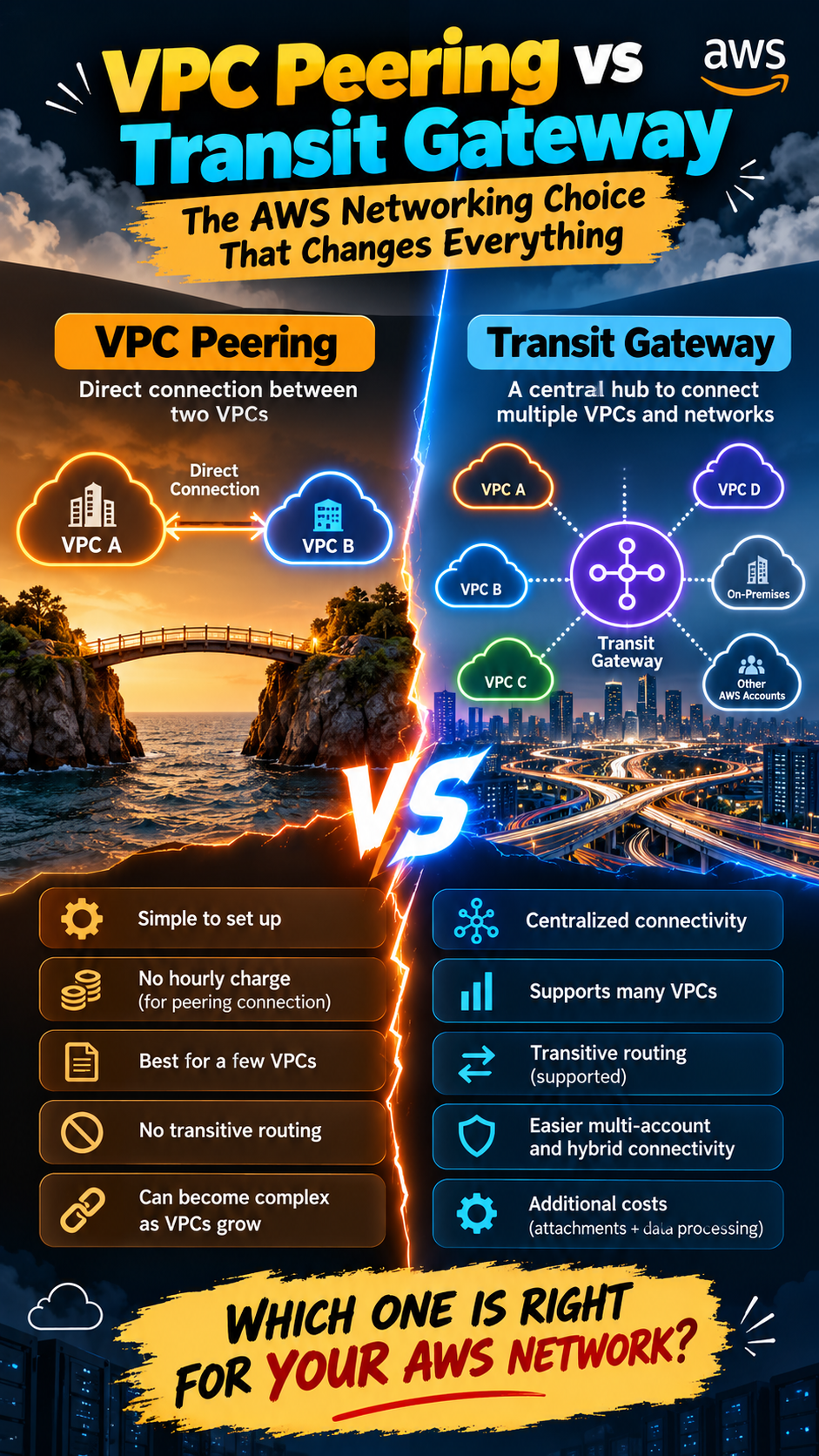
VPC Peering vs Transit Gateway: The AWS Networking Choice That Changes Everything
Introduction: One AWS Network, Two Very Different Approaches
Your AWS infrastructure starts small. One VPC hosts your application, another runs your database, and a third handles development and testing. Connecting them seems simple enough.
You set up VPC Peering, configure routes, and everything works.
But then your business grows. You add more AWS accounts, multiple environments, shared services, and workloads across different regions. Suddenly, managing network connections becomes complicated. Routing tables grow, connectivity becomes harder to troubleshoot, and your once-simple architecture starts turning into a networking maze.
This is where an important AWS architecture decision comes in: VPC Peering or AWS Transit Gateway?
Both help connect Amazon Virtual Private Clouds (VPCs), but they solve different networking problems. Choosing the right one can influence your infrastructure's scalability, security, complexity, and long-term cost.
Let's break down the differences and discover when each option makes sense.
What Is AWS VPC Peering?
VPC Peering creates a private network connection between two VPCs, allowing resources in those networks to communicate using private IP addresses.
Think of it as building a direct bridge between two islands. Traffic travels directly between the connected VPCs without requiring a centralized routing hub.
For example, imagine your architecture includes:
VPC A: Production application
VPC B: Database
VPC C: Development environment
You can establish separate peering connections between VPC A and VPC B, and between VPC A and VPC C.
However, VPC Peering does not support transitive routing. If VPC B is peered with VPC A, and VPC A is peered with VPC C, VPC B cannot automatically communicate with VPC C through VPC A.
Each required connection must be designed and configured separately.
Advantages of VPC Peering
Simple to configure for a small number of VPCs.
Supports private communication without a centralized network hub.
No additional hourly charge for the peering connection itself, although data transfer and related services may incur costs.
Useful for straightforward application-to-database connectivity and isolated network integrations.
Where VPC Peering Becomes Difficult
As the number of VPCs increases, the number of connections can grow quickly.
For a fully connected network of n VPCs, the maximum number of pairwise connections is:
n × (n − 1) ÷ 2
With 10 VPCs, that can mean 45 individual peering connections.
With 20 VPCs, it can reach 190.
Each connection may require route-table updates, access controls, monitoring, and ongoing maintenance. The result? More moving parts and a greater operational burden.
What Is AWS Transit Gateway?
AWS Transit Gateway acts as a centralized network hub that connects multiple VPCs and supported external networks.
Instead of creating direct connections between every pair of VPCs, you attach each VPC to the Transit Gateway and control communication through its routing configuration.
Think of it as an airport hub. Rather than building a separate route between every city, passengers travel through a central hub that connects different destinations.
For example, a company might connect:
Production VPC
Development VPC
Testing VPC
Shared services VPC
On-premises corporate network
Each network can connect to the Transit Gateway, subject to supported attachment types and routing configuration.
Transit Gateway can also support connectivity across multiple AWS accounts and hybrid environments, making it useful for organizations with larger network architectures.
Advantages of Transit Gateway
Centralized connectivity for many VPCs and supported networks.
Transitive routing, when permitted by route tables and network policies.
Better organization of complex, multi-account architectures.
Segmentation through Transit Gateway route tables.
Support for hybrid networking with VPN and, where configured, AWS Direct Connect.
Easier expansion as new VPCs and network environments are added.
What Should You Watch Out For?
Transit Gateway introduces additional costs, including attachment charges and data-processing charges, which vary by region and usage.
It also requires thoughtful routing, security, and monitoring. Centralization simplifies the overall topology, but it does not eliminate network design complexity.
VPC Peering vs Transit Gateway: Key Differences
FeatureVPC PeeringTransit GatewayArchitectureDirect connectionCentralized network hubTransitive routingNot supportedSupported, subject to route configurationBest suited forA few VPCsMany VPCs and hybrid networksScalabilityConnections grow as networks expandAdd attachments to a shared hubRouting managementConfigure routes for each connectionCentralized routing through TGW route tablesNetwork segmentationRoute tables and security controlsTGW route tables plus security controlsCost modelNo hourly peering connection fee; data transfer may cost extraAttachment and data-processing charges may applyHybrid connectivityPossible through additional network architectureSupports VPN and Direct Connect integrationOperational overheadCan increase with each new VPCOften easier to manage at scale
Important: Neither option automatically provides unrestricted access. Security groups, network ACLs, route tables, and other security controls still determine which traffic can flow.
Real-World Example: A Growing Company on AWS
Imagine a company that initially operates three VPCs.
Production hosts its customer-facing application. A second VPC contains the database, while a third supports testing.
At this stage, VPC Peering may be the practical choice. The architecture is small, the connectivity requirements are straightforward, and a centralized hub may add unnecessary expense.
Six months later, the company expands.
It now has 15 VPCs across several AWS accounts, shared monitoring services, a centralized security environment, and an on-premises office that needs access to selected cloud resources.
With a peering-based design, the team may have to maintain many connections and carefully manage routing across them.
With Transit Gateway, the team can attach the VPCs to a shared hub and use separate route tables to control which networks can communicate.
The result can be a more manageable architecture with clearer connectivity policies.
The lesson is simple: the networking solution that works today may not be the right solution for tomorrow.
When Should You Choose VPC Peering?
VPC Peering is a strong option when:
You need to connect only a small number of VPCs.
Communication requirements are direct and well defined.
You want to avoid Transit Gateway attachment and processing charges.
You don't need centralized transitive routing.
Your network architecture is unlikely to become significantly more complex soon.
For example, connecting one application VPC to a separate database VPC may not justify introducing a Transit Gateway.
When Should You Choose Transit Gateway?
Transit Gateway is worth considering when:
You operate multiple VPCs across multiple AWS accounts.
Your network needs to support transitive connectivity.
You require centralized connectivity between AWS and on-premises networks.
You want to segment environments using separate routing policies.
Your organization expects continued growth in cloud workloads.
For large enterprises, Transit Gateway can reduce the burden of managing numerous individual connections. However, the actual design should reflect traffic patterns, security boundaries, regional requirements, and cost.
The Hidden Cost Factor: Networking Is Not Just About Connectivity
One of the biggest mistakes in AWS architecture is choosing a networking service based only on its technical capabilities.
Cost matters, too.
With VPC Peering, the connection itself has no hourly fee, but data transfer charges can apply.
With Transit Gateway, costs can include hourly attachment charges and data processing. Inter-Region connectivity and other associated services may introduce additional charges.
Before deciding, ask:
How many VPCs need to communicate?
How much data will move between them?
Which networks actually need access to each other?
Will the architecture expand over the next 12–24 months?
Do we need hybrid connectivity or centralized inspection?
Would a hub simplify operations enough to justify its additional cost?
A small environment with heavy traffic between two VPCs may favor a different design from a large enterprise with dozens of networks.
Always validate the design against current AWS pricing for your region and expected traffic volume.
Can You Use VPC Peering and Transit Gateway Together?
Absolutely.
You don't have to choose one solution for every connection in your organization.
For example, Transit Gateway might serve as the central hub for production, development, shared services, and on-premises connectivity. A separate VPC Peering connection could serve a specific direct-connectivity requirement between two VPCs.
The important thing is to plan routes carefully and avoid unintended paths, overlapping CIDR ranges, or security gaps.
Your goal isn't to use the most powerful networking service everywhere. It's to build an architecture that is secure, maintainable, cost-effective, and fit for purpose.
Final Verdict: Which AWS Networking Option Wins?
There is no universal winner.
Choose VPC Peering for simplicity. Choose Transit Gateway for centralized connectivity at scale.
If your environment contains just a few VPCs with straightforward communication requirements, VPC Peering can be efficient and economical.
If your environment spans multiple accounts, numerous VPCs, and hybrid networks, Transit Gateway can provide a more scalable foundation.
The best AWS networking architecture isn't necessarily the most complex one. It's the one that meets your current requirements without making future growth unnecessarily difficult.
Because in cloud architecture, a networking decision is never just about connecting two VPCs. It's about deciding how your entire infrastructure will communicate as your business grows.
Building or scaling your AWS infrastructure?
At Savishty, we help organizations navigate cloud architecture, AWS infrastructure, migration, modernization, and cost optimization.
Explore our services: https://savishty.com/
Did you find this helpful?