DevOps vs Platform Engineering: What Should Companies Choose? | Savishty
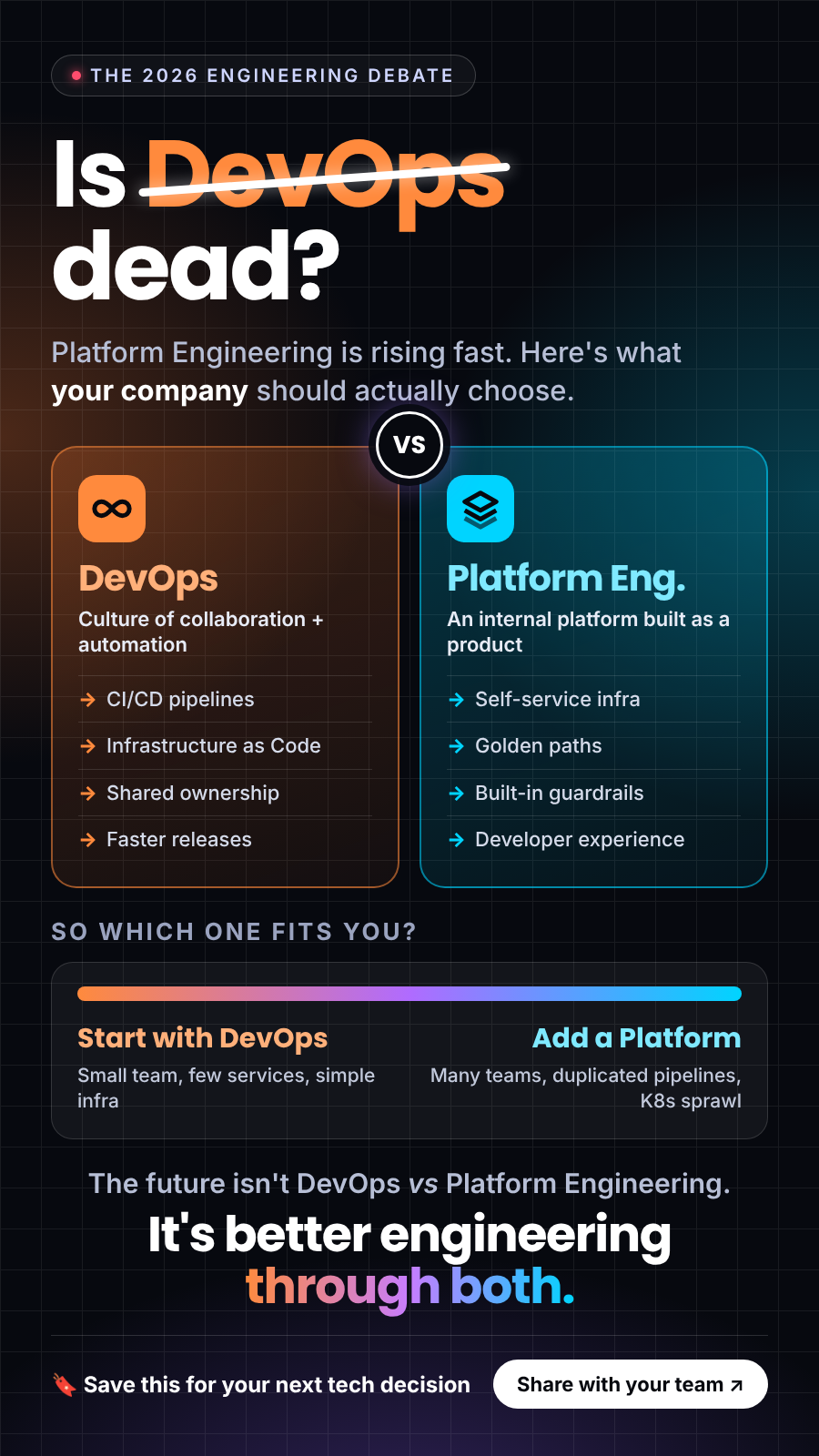
DevOps vs Platform Engineering: What Should Companies Choose?
DevOps helped companies deliver software faster. Now Platform Engineering is changing how development teams work. But does that mean DevOps is becoming outdated?
As software development becomes more complex, companies are looking for ways to improve developer productivity, automate infrastructure, reduce deployment delays, and maintain reliable systems.
For years, DevOps has been the preferred approach to connecting development and operations teams. But as organizations adopt cloud-native applications, microservices, Kubernetes, CI/CD pipelines, and AI-powered workloads, another approach is gaining attention: Platform Engineering.
Many companies are now asking an important question:
Should we continue investing in DevOps, or is it time to build an internal developer platform?
The answer depends on your company's size, engineering maturity, infrastructure complexity, and development goals.
Let's understand the difference and explore which approach makes more sense for modern businesses.
1. What Is DevOps?
DevOps is a combination of Development and Operations. It is a culture, set of practices, and collection of tools designed to improve collaboration between software developers and IT operations teams.
Traditionally, development and operations worked separately. Developers built applications, while operations teams handled deployment, infrastructure, and maintenance.
This separation often created delays, communication gaps, and deployment problems.
DevOps aims to remove these barriers through collaboration, automation, continuous integration, and continuous delivery.
What does DevOps focus on?
CI/CD Automation: Automating code integration, testing, and deployment.
Infrastructure as Code: Managing infrastructure through code instead of manual configuration.
Monitoring and Logging: Tracking application performance, errors, and system health.
Cloud Management: Managing infrastructure across platforms such as AWS, Azure, and Google Cloud.
Collaboration: Bringing development, operations, and security teams closer together.
Faster Releases: Helping teams deliver software updates more frequently and reliably.
Popular DevOps tools
GitHub Actions and Jenkins for CI/CD.
Docker for containerization.
Kubernetes for container orchestration.
Terraform for Infrastructure as Code.
Ansible for configuration management.
Prometheus and Grafana for monitoring.
AWS, Azure, and Google Cloud for infrastructure.
The primary objective of DevOps is simple: help teams build, test, release, and operate software more efficiently.
2. What Is Platform Engineering?
Platform Engineering takes automation and developer enablement a step further.
Instead of expecting every development team to independently manage infrastructure, deployment pipelines, monitoring, security configurations, and cloud resources, companies build an internal platform that provides these capabilities through standardized, reusable services.
This platform is commonly known as an Internal Developer Platform (IDP).
Think of it as an internal product designed for developers.
Developers can use a self-service interface, templates, workflows, and approved tools to create environments, deploy applications, and access infrastructure without having to understand every underlying operational detail.
What does Platform Engineering focus on?
Self-Service Infrastructure: Developers can provision approved resources without waiting for manual operations support.
Golden Paths: Pre-approved templates and workflows for common development tasks.
Developer Experience: Reducing unnecessary complexity and helping developers focus on building products.
Standardization: Applying consistent security, compliance, and infrastructure practices.
Reusable Components: Creating common deployment pipelines, infrastructure modules, and service templates.
Governance: Building security and operational requirements into the platform.
Popular Platform Engineering tools
Backstage for developer portals and service catalogs.
Kubernetes for container orchestration.
Terraform for infrastructure provisioning.
Crossplane for managing infrastructure through Kubernetes APIs.
Argo CD and Flux for GitOps-based deployments.
Helm for Kubernetes application packaging.
Prometheus and Grafana for observability.
The primary objective of Platform Engineering is to make software delivery easier by providing developers with a reliable, standardized, self-service platform.
3. DevOps vs Platform Engineering: Key Differences
Although both approaches aim to improve software delivery, their focus is different.
AreaDevOpsPlatform EngineeringPrimary focusCollaboration and automationDeveloper experience and self-serviceApproachPractices and cultureInternal platform as a productInfrastructureTeams automate and manage infrastructurePlatform provides standardized infrastructure capabilitiesDeveloper experienceDepends on team workflows and toolingSimplified through reusable workflowsAutomationCI/CD, testing, deployment, monitoringSelf-service provisioning and automated workflowsStandardizationEstablished through team practicesBuilt into platform templates and guardrailsResponsibilityShared across development and operationsPlatform team provides capabilities; product teams retain service ownershipBest suited forTeams improving delivery and collaborationOrganizations managing growing engineering complexity
The key difference: DevOps improves how teams collaborate and deliver software. Platform Engineering builds systems that make those workflows easier to repeat at scale.
4. Why Are Companies Moving Towards Platform Engineering?
DevOps is not disappearing. However, the way organizations implement DevOps is evolving.
As engineering teams grow, managing infrastructure and deployment workflows becomes increasingly complicated.
A company with five developers may manage its own deployment pipelines without much difficulty.
But imagine an organization with 100 developers working across 20 different services.
Different teams may use different deployment processes, infrastructure configurations, monitoring tools, and security practices.
This creates several challenges.
1. Too Much Operational Work for Developers
Developers should spend most of their time building and improving products.
However, they may spend hours configuring deployment pipelines, requesting infrastructure, troubleshooting environments, and managing permissions.
Platform Engineering reduces repetitive operational work through self-service capabilities.
2. Inconsistent Development Environments
Different teams may follow different deployment standards.
This can create configuration errors, security gaps, and unexpected production issues.
An internal platform provides standardized templates and approved workflows.
3. Infrastructure Complexity Is Increasing
Modern applications increasingly rely on containers, microservices, cloud infrastructure, databases, APIs, and distributed systems.
Managing these components independently across multiple teams can become difficult.
Platform Engineering helps simplify access to these capabilities.
4. Faster Development Without Sacrificing Security
Companies want faster releases, but speed cannot come at the cost of security and compliance.
Platforms can include predefined security policies, access controls, approved infrastructure configurations, and automated checks.
5. Better Developer Productivity
When developers can create environments, deploy applications, and access approved services through self-service workflows, they spend less time waiting for operational support.
The result can be a smoother development experience and more consistent delivery.
5. When Should a Company Choose DevOps?
Not every company needs a dedicated Platform Engineering team.
For startups and smaller engineering organizations, a well-designed DevOps approach may be more than enough.
DevOps is a strong choice when:
Your engineering team is relatively small.
You have a limited number of applications and services.
Your infrastructure is not overly complex.
Developers and operations teams already collaborate effectively.
Your deployment processes can be managed with existing automation.
You do not yet have enough repeated workflows to justify building an internal platform.
Example:
A startup with 8 developers running an application on AWS may use GitHub Actions, Docker, Terraform, and Amazon ECS to automate deployments.
Building a separate internal developer platform at this stage could introduce unnecessary cost and complexity.
The smarter decision may be to strengthen the existing DevOps workflow first.
6. When Should a Company Choose Platform Engineering?
Platform Engineering becomes more valuable when engineering complexity starts slowing down development teams.
Consider investing in it when:
Multiple development teams manage different applications.
Developers repeatedly request infrastructure and deployment support.
Teams maintain separate CI/CD pipelines with duplicated effort.
Kubernetes and cloud environments are becoming difficult to manage.
Security and compliance standards need consistent enforcement.
Infrastructure provisioning takes too long.
Developers struggle to understand which tools and workflows to use.
The engineering organization needs standardized self-service capabilities.
Example:
Imagine an enterprise with 150 developers managing 40 microservices across multiple AWS environments.
Each team has its own deployment pipeline, monitoring setup, and infrastructure configuration.
The company can create an internal developer platform with reusable deployment templates, infrastructure modules, service catalogs, and automated security controls.
Instead of every team solving the same infrastructure problems independently, developers can use standardized workflows.
This is where Platform Engineering can deliver significant value.
7. Can DevOps and Platform Engineering Work Together?
Absolutely. In fact, this is often the most practical approach.
One common misconception is that companies must choose between DevOps and Platform Engineering.
They do not.
Platform Engineering builds on many DevOps principles, including automation, Infrastructure as Code, CI/CD, monitoring, and collaboration.
The two approaches can work together.
Consider this model:
DevOps practices → Platform Engineering capabilities → Better developer experience
Here is how responsibilities can work:
DevOps / Product Engineering Teams
Build and maintain applications.
Own application quality and reliability.
Participate in CI/CD and incident response.
Define application-level monitoring requirements.
Platform Engineering Team
Build and maintain the internal developer platform.
Provide reusable infrastructure and deployment templates.
Manage platform-level automation and developer tooling.
Establish security guardrails and standard workflows.
Improve the platform based on developer feedback.
The platform team should not become another operations department that developers must wait for.
Its purpose is to reduce friction by providing reliable services that developers can use independently.
8. How AWS Supports DevOps and Platform Engineering
Cloud platforms such as AWS provide services that support both approaches.
However, the implementation differs depending on the company's requirements.
AWS services commonly used in DevOps
AWS CodePipeline: Automates application release workflows.
AWS CodeBuild: Builds and tests application code.
Amazon ECS: Runs and manages containerized applications.
Amazon EKS: Provides managed Kubernetes.
AWS CloudFormation: Automates infrastructure provisioning.
Amazon CloudWatch: Supports monitoring, logging, and observability.
AWS IAM: Manages access permissions.
AWS services and tools useful for Platform Engineering
Amazon EKS: Provides a foundation for Kubernetes-based platforms.
AWS Service Catalog: Helps organizations create and manage approved self-service infrastructure products.
AWS Control Tower: Supports multi-account governance and standardized account environments.
AWS IAM Identity Center: Helps manage workforce access to AWS accounts and applications.
AWS CloudFormation and Terraform: Enable reusable infrastructure templates.
Amazon CloudWatch: Provides platform and application observability.
For example, a company can use Amazon EKS, Terraform, Backstage, and GitOps tools to create an internal developer platform.
Developers can access approved templates, deploy applications, and request standardized infrastructure while the platform team manages the underlying capabilities.
The right architecture depends on the organization's scale, security requirements, cloud strategy, and engineering maturity.
9. Common Mistakes Companies Should Avoid
Adopting a new engineering approach does not automatically improve productivity.
Companies should avoid these common mistakes:
1. Building a Platform Too Early
A small team may not need an internal developer platform. Start with practical DevOps automation and introduce platform capabilities when repeated problems justify them.
2. Treating Platform Engineering as Just a Tool
Installing Backstage or Kubernetes does not automatically create Platform Engineering. A successful platform requires ownership, standards, documentation, support, and continuous improvement.
3. Creating Too Much Complexity
A platform should simplify development, not introduce additional layers of approvals, tools, and processes.
4. Ignoring Developer Feedback
The platform is an internal product. Developers are its users. Their feedback should influence its design and roadmap.
5. Forgetting Security and Cost Management
Self-service infrastructure must include appropriate access controls, resource limits, monitoring, and cost visibility.
6. Removing Ownership from Development Teams
A platform can simplify infrastructure management, but application teams should still understand and own the reliability and performance of their services.
10. How to Decide: DevOps or Platform Engineering?
Before making a decision, companies should evaluate their engineering maturity and operational challenges.
Business situationRecommended approachSmall development teamStart with DevOpsManual deployment processesImprove DevOps automationMultiple teams duplicating pipelinesIntroduce reusable platform capabilitiesDevelopers waiting for infrastructureBuild self-service workflowsGrowing Kubernetes complexityConsider Platform EngineeringInconsistent security configurationsStandardize through platform guardrailsLarge engineering organizationConsider a dedicated platform teamLimited infrastructure complexityAvoid unnecessary platform overhead
A useful way to approach the decision is to ask:
How much developer time is spent on infrastructure-related tasks?
Are teams repeatedly solving the same deployment problems?
How long does it take to provision a new environment?
Are security and compliance requirements applied consistently?
Is infrastructure complexity slowing down product development?
If these problems are becoming recurring organizational bottlenecks, Platform Engineering may be worth considering.
11. The Future: Developer Experience Will Become a Competitive Advantage
Software development is changing.
Cloud-native architecture, AI-assisted coding, microservices, automation, and distributed engineering teams are increasing the speed at which companies build software.
But writing code faster does not automatically mean delivering products faster.
Infrastructure provisioning, deployment workflows, security checks, testing, monitoring, and production reliability still matter.
This is why developer experience is becoming an important engineering priority.
DevOps established the foundation for collaboration and automation.
Platform Engineering is helping organizations turn those practices into reusable capabilities that can support larger engineering teams.
In the coming years, companies that make infrastructure easier to access and software delivery more consistent may gain an advantage in engineering productivity.
However, the goal should not be to adopt the latest trend. It should be to solve real problems without creating unnecessary complexity.
Final Thoughts: What Should Companies Choose?
DevOps is not dead. Platform Engineering is not a replacement for DevOps.
They solve related but different challenges.
DevOps helps teams collaborate, automate, and deliver software efficiently.
Platform Engineering builds internal capabilities that make those workflows consistent, reusable, and easier to access.
For startups and smaller teams, investing in DevOps fundamentals is usually the right starting point.
For growing organizations with multiple engineering teams, repeated infrastructure tasks, and increasing operational complexity, Platform Engineering can be the next logical step.
The smartest companies will not choose a technology because it is trending.
They will choose an approach that helps developers spend less time managing complexity and more time building products.
The future is not DevOps versus Platform Engineering. It is better engineering through both.
Did you find this helpful?