RAG Is Powerful, But What Happens When Your Knowledge Base Gets Outdated? | Savishty
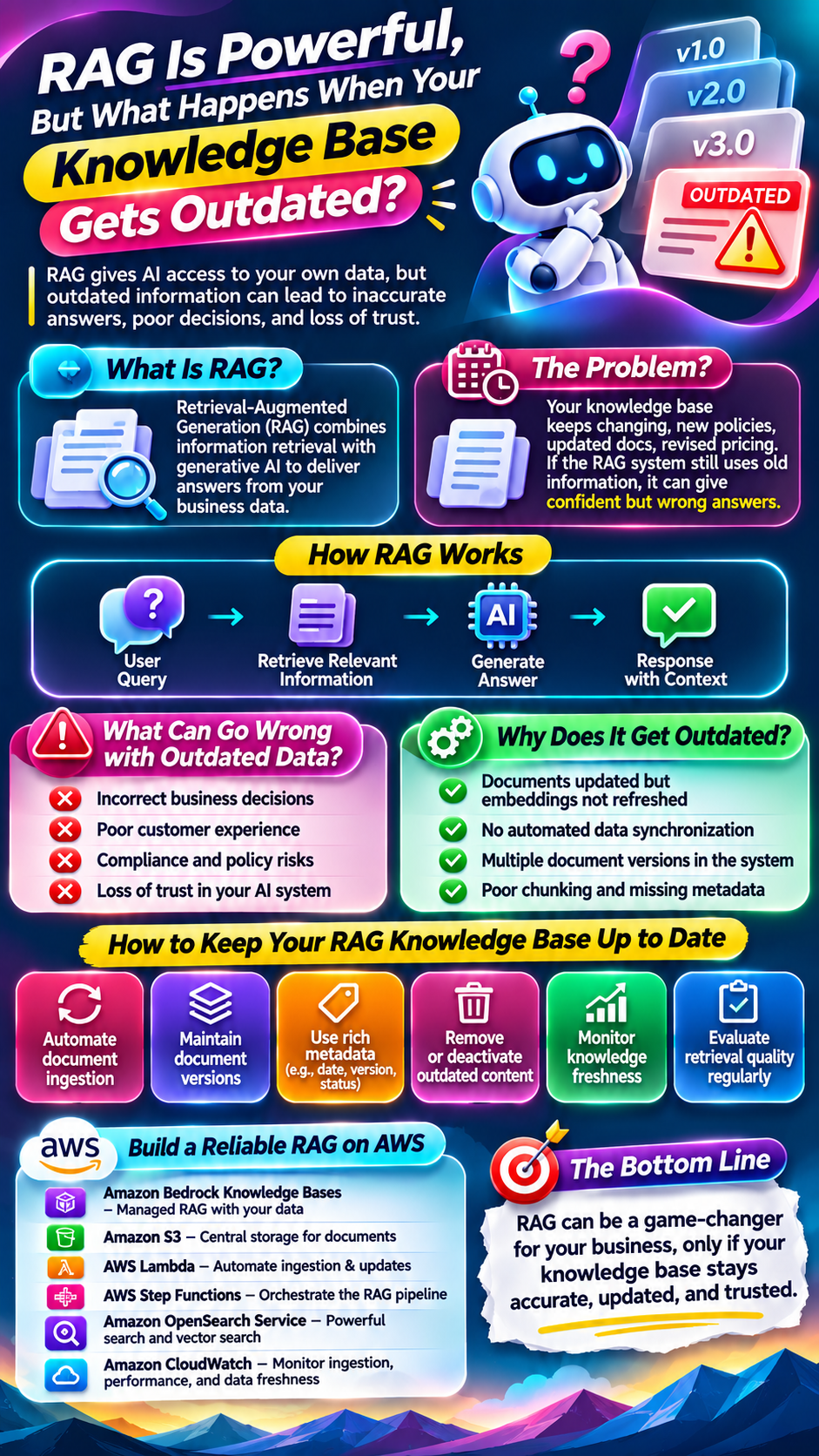
RAG Is Powerful, But What Happens When Your Knowledge Base Gets Outdated?
Imagine asking an AI-powered customer support assistant about your company's latest refund policy.
The AI responds confidently, explains the process, and even provides step-by-step instructions.
But there's one problem.
The refund policy was updated three months ago, and the AI is still using the old information.
The answer sounds correct. The explanation looks professional. But the information is outdated.
This is one of the biggest challenges businesses face when implementing Retrieval-Augmented Generation (RAG).
RAG has become a popular approach for building AI applications that can retrieve information from company documents, databases, knowledge bases, and other trusted sources.
But building a RAG application is only the beginning.
What happens when the information your AI retrieves is no longer accurate?
Let's understand why outdated knowledge bases can become a serious problem, how they affect AI applications, and what businesses can do to keep their RAG systems reliable.
1. What Is RAG and Why Does It Matter?
Retrieval-Augmented Generation (RAG) is an approach that combines information retrieval with generative AI.
Instead of relying only on information learned during model training, a RAG application retrieves relevant information from an external knowledge source and uses it to generate a response.
For example, imagine an organization building an internal AI assistant.
Employees can ask questions such as:
What is our latest leave policy?
How do I request reimbursement?
What is the current onboarding process?
Which security guidelines should developers follow?
The RAG application searches the organization's knowledge base, retrieves relevant content, and provides it to the AI model as context.
A simplified RAG workflow looks like this:
A user submits a question.
The application converts the question into a searchable representation.
The retrieval system searches the knowledge base.
Relevant document sections are retrieved.
The AI model uses that information to generate an answer.
The response is returned to the user.
<AsyncImage query="Retrieval augmented generation RAG architecture workflow user query embedding vector database retrieval LLM response infographic" aspectRatio="16:9" width="100%"/>
This approach helps businesses build AI applications that can work with their own information.
However, RAG is only as reliable as the information it retrieves.
2. The Hidden Problem: Your Knowledge Base Is Getting Older
A knowledge base is not a static collection of documents.
Business information changes constantly.
Consider an organization that maintains documents covering:
Product specifications.
Pricing information.
Customer support policies.
Employee guidelines.
Technical documentation.
Compliance requirements.
Internal procedures.
Over time, these documents are updated, replaced, or deleted.
But what if the RAG system continues retrieving information from older versions?
This creates a freshness problem.
For example:
Business InformationWhat ChangedPotential AI ProblemProduct pricingPrices were updatedAI provides incorrect pricesHR policiesLeave rules changedEmployees receive outdated guidanceProduct documentationFeatures were modifiedAI explains unavailable featuresSecurity policiesNew controls were introducedAI recommends outdated practicesCustomer support FAQsRefund process changedCustomers receive incorrect instructions
The problem is not necessarily the language model.
The retrieval pipeline may simply be providing outdated information.
3. Why Does a RAG Knowledge Base Become Outdated?
There are several reasons why a RAG application may continue using old information.
A. Documents Are Updated but Embeddings Are Not
One of the most common problems occurs when the original document changes but its corresponding embeddings are not refreshed.
In a typical RAG architecture, documents are divided into smaller sections called chunks.
These chunks are converted into vector embeddings and stored in a vector database or search index.
When the original document changes, the system needs to process the updated content and refresh the relevant indexed information.
If this does not happen, the retrieval system may continue returning old content.
The solution:
Detect changes in source documents.
Reprocess updated content.
Generate new embeddings where required.
Update the vector index.
Remove or deactivate obsolete document versions.
B. No Automated Data Synchronization
Some organizations rely on manual uploads to update their knowledge bases.
This works when documents rarely change.
But it becomes difficult when hundreds or thousands of documents are updated regularly.
For example, a company may update its product documentation every week, but the AI knowledge base is refreshed only once a month.
During that gap, users may receive outdated responses.
The solution:
Build an automated ingestion pipeline that detects new, modified, and deleted documents and processes those changes.
C. Old Documents Are Still Being Retrieved
Even when updated documents are available, older versions may remain inside the knowledge base.
Imagine a company has three versions of its employee reimbursement policy.
All three documents contain similar keywords.
When an employee asks about reimbursement limits, the retrieval system may return an older version instead of the latest approved policy.
This is a document versioning problem.
The solution:
Maintain document version information.
Track publication and effective dates.
Mark outdated documents as inactive.
Apply metadata filters during retrieval.
Give preference to approved and current sources.
D. Poor Chunking and Metadata Management
RAG systems divide documents into chunks to make retrieval more effective.
However, poorly designed chunking can separate important information from its context.
For example, a policy document may contain a date and version number at the beginning, while the actual policy details are stored in separate chunks.
The retrieval system may find the policy text without identifying which version it belongs to.
This can create confusing or inaccurate responses.
The solution:
Use meaningful chunking strategies and attach metadata such as:
Document ID.
Document version.
Last updated date.
Publication status.
Department or category.
Source location.
Effective date.
Good metadata helps retrieval systems identify relevant and current information.
4. What Happens When AI Retrieves Outdated Information?
Outdated knowledge bases can create more than just inaccurate answers.
They can affect business operations and customer trust.
1. Incorrect Business Decisions
An AI assistant may provide outdated financial figures, product information, or operational guidelines.
Employees might make decisions based on information that is no longer valid.
2. Poor Customer Experience
Imagine a customer asking about a product's current features or refund policy.
If the AI provides outdated information, customers may lose confidence in the service.
3. Compliance and Policy Risks
In industries where policies and regulatory requirements change frequently, outdated information can create serious operational risks.
AI systems should not treat old compliance documents as current guidance.
4. Reduced Trust in AI Applications
Users expect AI assistants to provide useful and reliable information.
When an application repeatedly provides outdated answers, users may stop relying on it.
An intelligent AI system is not necessarily a reliable AI system if its knowledge is not maintained.
5. How to Keep Your RAG Knowledge Base Updated
Keeping a RAG system reliable requires more than updating documents occasionally.
Organizations need a structured process for maintaining their knowledge sources.
Here are six practical approaches.
A. Automate Document Ingestion
Create a pipeline that detects when documents are created, updated, or deleted.
For example, when a new policy document is uploaded to Amazon S3, an event-driven workflow can trigger document processing.
The pipeline can:
Detect the document change.
Extract the document content.
Clean and prepare the text.
Divide the content into chunks.
Generate or update embeddings.
Update the retrieval index.
Record the processing status.
This reduces dependence on manual knowledge base updates.
B. Implement Document Version Control
Every important document should have a clear version history.
The system should identify which document is current, which version is approved, and which versions are no longer valid.
For example:
Policy Version 1.0 – Archived.
Policy Version 2.0 – Archived.
Policy Version 3.0 – Current and approved.
Retrieval should prioritize the approved version rather than simply returning the most similar document.
C. Use Metadata-Based Filtering
Metadata helps the retrieval system distinguish between documents with similar content.
For example, an AI assistant answering HR questions could prioritize documents with:
Department: HR.
Status: Approved.
Version: Latest.
Effective date: Current.
This can reduce the likelihood of retrieving irrelevant or outdated information.
However, metadata must be maintained accurately. Incorrect version labels can create the same problem they are intended to prevent.
D. Remove or Deactivate Outdated Information
Updating documents is only one part of knowledge base maintenance.
Old information must also be handled properly.
If a document is deleted or replaced, the corresponding chunks and embeddings should be removed, updated, or made unavailable for retrieval.
Otherwise, obsolete information may continue appearing in AI responses.
E. Monitor Knowledge Base Freshness
Organizations should monitor how frequently their knowledge sources are updated.
Useful metrics include:
Time since the last successful ingestion.
Number of documents awaiting processing.
Failed ingestion jobs.
Documents with expired or outdated versions.
Index synchronization delays.
Retrieval results from obsolete sources.
These metrics help teams identify knowledge freshness problems before users encounter them.
F. Evaluate Retrieval Quality Regularly
A RAG system should be tested against questions with known, approved answers.
For example:
If a company's refund policy changes from 15 days to 30 days, the evaluation system should verify that the AI retrieves and communicates the new policy.
Testing should include:
Questions based on updated documents.
Questions involving deleted information.
Questions where multiple document versions exist.
Questions with conflicting sources.
Questions where no reliable answer is available.
The AI should also be able to acknowledge when the required information cannot be found.
6. How AWS Can Help Build a More Reliable RAG Architecture
For businesses building RAG applications on AWS, several services can support document processing, retrieval, storage, and monitoring.
Amazon Bedrock Knowledge Bases
Amazon Bedrock Knowledge Bases helps developers connect foundation models with external data sources through managed RAG capabilities.
It supports workflows for ingesting data, preparing it for retrieval, and providing relevant context to foundation models.
For knowledge freshness, organizations should configure and monitor synchronization or ingestion workflows so that changes in supported data sources are reflected in the knowledge base.
Amazon S3
Amazon S3 can act as a central storage location for documents, product manuals, policies, and other knowledge sources.
Organizations can use event notifications and integrations to trigger processing when relevant objects change.
AWS Lambda
AWS Lambda can run event-driven processing tasks, such as document validation, metadata updates, and ingestion orchestration.
AWS Step Functions
AWS Step Functions can coordinate multi-step ingestion workflows.
For example, a workflow may extract documents, process text, validate metadata, update a knowledge base, and record the result.
Amazon OpenSearch Service
Amazon OpenSearch Service supports search and vector search capabilities that can be used in RAG architectures.
It can help applications retrieve relevant document chunks using suitable indexing and retrieval configurations.
Amazon CloudWatch
CloudWatch can help monitor ingestion workflows, application errors, processing delays, and operational performance.
<AsyncImage query="AWS RAG architecture diagram Amazon S3 document ingestion Lambda Step Functions Bedrock Knowledge Bases vector database CloudWatch" aspectRatio="16:9" width="100%"/>
The right combination depends on the application's scale, data sources, retrieval requirements, and operational needs.
7. RAG Knowledge Base Maintenance Checklist
Before deploying a RAG application into production, businesses should consider the following:
Identify trusted and approved data sources.
Automate document ingestion.
Detect document changes and deletions.
Maintain document version history.
Use metadata for effective retrieval.
Remove obsolete document chunks.
Monitor synchronization failures.
Track knowledge base freshness.
Test retrieval using updated information.
Evaluate response accuracy regularly.
Provide source references where appropriate.
Define how the AI should respond when information is unavailable.
A RAG application should be treated as a continuously maintained system, not a one-time AI project.
Final Thoughts
RAG has changed how businesses build AI applications by allowing models to work with external and organization-specific information.
But there is one important detail that organizations cannot ignore.
Your AI assistant can only provide reliable answers when the information it retrieves is reliable and up to date.
Outdated documents, stale embeddings, poor metadata, and incomplete synchronization can undermine even a well-designed RAG architecture.
Businesses need automated ingestion, document version control, metadata management, monitoring, and regular retrieval evaluation to keep their AI systems useful.
AWS provides services such as Amazon Bedrock Knowledge Bases, S3, Lambda, Step Functions, OpenSearch Service, and CloudWatch that can support these workflows.
Did you find this helpful?