AWS vs Azure vs Google Cloud: Which One Should Your Business Choose in 2026? | Savishty
The Wrong Question Is: “Which Cloud Is Best?”
A founder asks:
“Should we go with AWS, Azure, or Google Cloud?”
It sounds like a simple question.
It isn't.
It's a little like asking:
“Which car is the best?”
A sports car might be perfect for one person and completely impractical for another.
The same thing happens with cloud.
AWS, Microsoft Azure, and Google Cloud are all powerful platforms. All three can run serious production workloads, support AI, provide databases and storage, and scale applications globally.
The interesting part isn't figuring out which one is the best.
It's figuring out which one makes the most sense for your business.
And that's where the comparison gets useful.
First, Let's Get One Thing Straight
The cloud market isn't a three-way race where one company wins everything.
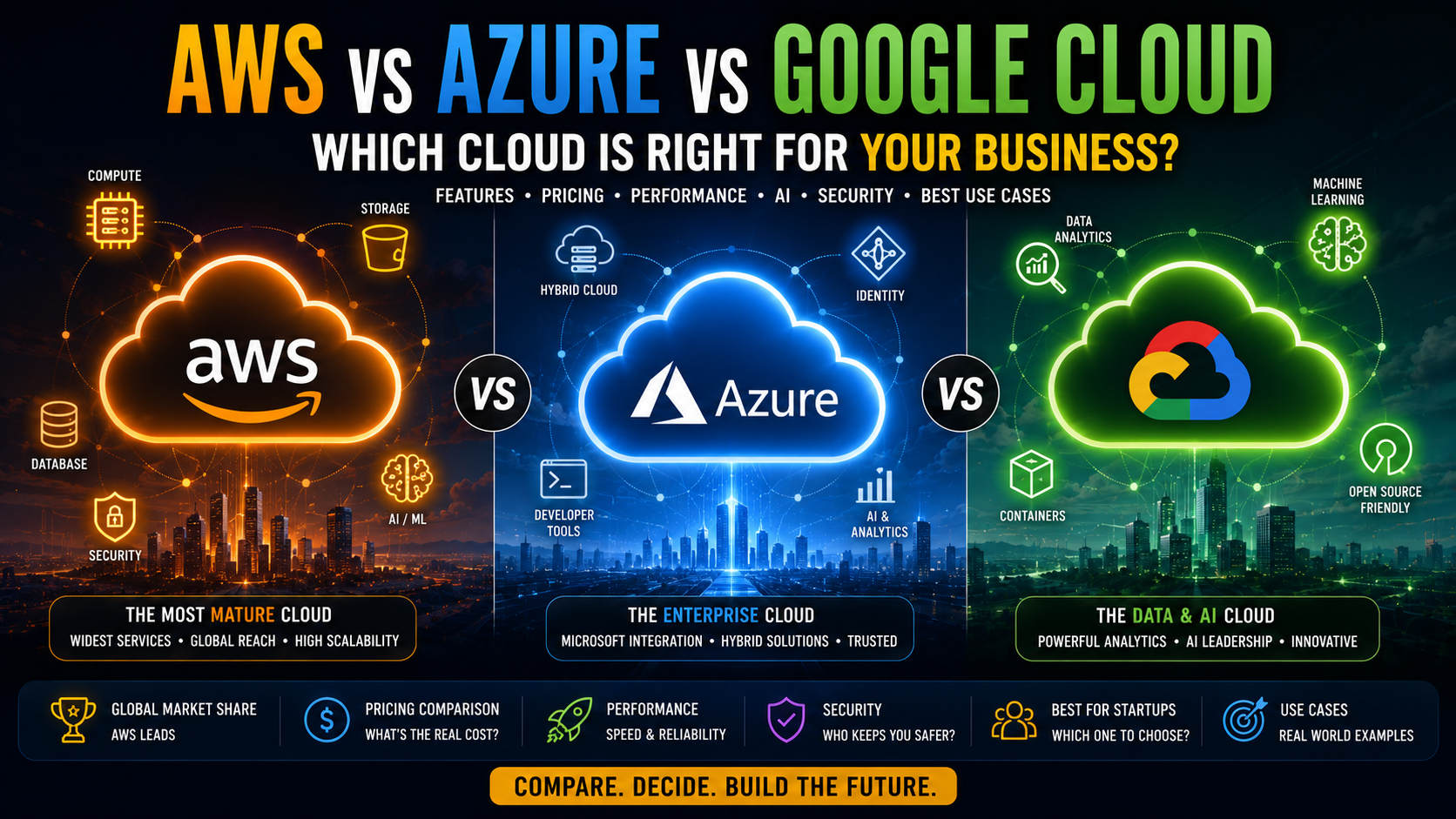
AWS remains the market leader, while Azure and Google Cloud have built significant positions of their own. In Q1 2026, estimates put AWS at about 28% of global cloud infrastructure spending, Azure at 21%, and Google Cloud at 14%. �
Statista
So this isn't a case of:
Good → Better → Best
It's more like:
Different strengths → Different businesses → Different choices
AWS: The “I Want Options” Cloud
AWS is often the first name that comes up when businesses talk about cloud.
And there's a reason.
AWS has been in the cloud game for a long time and has built a huge ecosystem of services covering computing, storage, databases, networking, security, analytics, AI, containers, serverless applications, and much more.
If your business has a complicated requirement, there's a good chance AWS already has a service designed for it.
Think:
EC2 for computing
S3 for storage
RDS for databases
Lambda for serverless workloads
CloudWatch for monitoring
IAM for access management
Bedrock for generative AI
And that's barely scratching the surface.
Google's own service comparison maps hundreds of capabilities across AWS, Azure, and Google Cloud, showing just how broad the three platforms have become. �
Google Cloud Documentation
AWS makes a lot of sense when:
You need a broad range of cloud services
You're building a complex application
You want extensive infrastructure flexibility
You have AWS-skilled developers
You're building AI/ML or data workloads
You're migrating large enterprise workloads
The downside?
AWS can feel overwhelming.
There are so many services, configurations, pricing options, and architectural choices that inexperienced teams can easily overcomplicate things.
AWS gives you a massive toolbox.
You still need to know which tools to use.
Azure: The “We Already Live in Microsoft” Cloud
Now imagine your company already runs on:
Microsoft 365.
Windows Server.
Active Directory.
Microsoft SQL Server.
Teams.
Power Platform.
Dynamics.
Suddenly, Azure becomes a very interesting option.
Azure's biggest advantage for many organizations isn't necessarily a single technical feature.
It's integration with the Microsoft ecosystem.
If your employees and systems are already deeply connected to Microsoft products, Azure can feel like a natural extension of what you already have.
Instead of introducing an entirely different environment, businesses can connect cloud infrastructure with technologies they already use.
Azure can be particularly attractive for:
Microsoft-heavy enterprises
Windows workloads
.NET applications
SQL Server environments
Hybrid cloud deployments
Organizations already invested in Microsoft technologies
Enterprises looking closely at Microsoft's AI ecosystem
And Azure isn't simply “the Microsoft cloud” anymore.
It's competing aggressively across AI, data, infrastructure, security, and enterprise cloud.
Google Cloud: The “Data and AI” Contender
Google Cloud has a different reputation.
When people think about Google, they naturally think about:
Search.
Data.
AI.
Machine learning.
And those strengths show up in Google Cloud's product ecosystem.
Services such as BigQuery and Vertex AI have made Google Cloud particularly interesting for organizations working heavily with analytics, machine learning, and AI.
Google's own comparison documentation positions Vertex AI alongside AWS SageMaker and Azure's AI/ML offerings, while BigQuery is compared with services such as Amazon Redshift and Azure analytics platforms. �
Google Cloud Documentation
Google Cloud can be a strong fit for:
Data-heavy businesses
Analytics teams
Machine learning workloads
AI-focused startups
Organizations already using Google technologies
Businesses building modern data platforms
Google Cloud may not always be the first platform a traditional enterprise considers.
But for companies where data and AI are central to the product, it deserves serious attention.
AWS vs Azure vs Google Cloud: A Practical Comparison
Area
AWS
Azure
Google Cloud
Overall ecosystem
Very broad
Very broad
Broad and focused
Enterprise adoption
Excellent
Excellent
Strong
Microsoft integration
Good
Excellent
Moderate
Data & analytics
Excellent
Excellent
Excellent
AI/ML
Excellent
Excellent
Excellent
Startup flexibility
Excellent
Excellent
Excellent
Service variety
Extremely broad
Extremely broad
Broad
Hybrid environments
Strong
Very strong
Strong
Best known for
Breadth & flexibility
Enterprise + Microsoft
Data + AI
These are practical positioning differences, not absolute rankings. Each platform changes rapidly.
What About Pricing?
Here's where things get messy.
You'll often see articles claiming:
“AWS is cheaper.”
Or:
“Azure is cheaper.”
Or:
“Google Cloud has the best pricing.”
The truth?
It depends.
Your cloud bill depends on what you're running, how much you're using, where workloads are located, storage requirements, networking, databases, discounts, commitments, architecture, and dozens of other factors.
Two companies can run the same cloud provider and receive completely different bills.
In fact, choosing a cloud provider based purely on the advertised price of one service can be a mistake.
The better question is:
What will our total cost of ownership look like?
That includes:
Infrastructure
Migration
Licensing
Data transfer
Storage
Support
Security
Monitoring
Engineering time
Training
Operations
The cheapest virtual machine isn't necessarily the cheapest cloud strategy.
And Then There's AI
This is where the comparison gets even more interesting.
AI is becoming one of the biggest drivers of cloud infrastructure demand. Recent reporting notes that major hyperscalers continue to invest heavily in AI infrastructure as demand for computing capacity remains strong. �
Reuters
AWS has Amazon Bedrock and SageMaker.
Azure has its expanding Azure AI ecosystem and deep Microsoft AI integration.
Google Cloud has Vertex AI and Google's broader AI technology stack.
So if you're building an AI company, don't just ask:
“Which cloud has the best AI?”
Ask:
Where is our data?
Which models do we want to use?
What compute do we need?
What does inference cost?
Which tools does our engineering team already know?
How important are managed AI services to us?
That's a much better conversation.
What If You're Already Using One Cloud?
Don't switch just because another provider has a cool new service.
Cloud migration isn't like changing your Netflix subscription.
Moving applications, databases, data, networking, security policies, integrations, and operational processes can take significant time and effort.
Sometimes the smartest decision is to optimize what you already have.
And sometimes a multi-cloud or hybrid approach makes sense.
For example:
AWS for core infrastructure
Azure for Microsoft workloads
Google Cloud for specialized analytics or AI
That can work.
But it also introduces complexity.
More clouds mean more:
Skills to maintain
Security policies
Billing systems
Monitoring tools
Integrations
Operational processes
Multi-cloud isn't automatically smarter.
It's smarter only when there's a business reason for it.
So Which Cloud Should a Startup Choose?
If you're a startup starting from scratch, don't begin with a cloud provider.
Start with the product.
Ask:
What are we building?
What data will we generate?
How quickly might we scale?
What does our engineering team know?
Do we need advanced AI?
Are we likely to integrate heavily with Microsoft?
How important are analytics and machine learning?
Then choose.
For example:
Choose AWS if...
You want a broad ecosystem and maximum flexibility.
Consider Azure if...
Your business already lives heavily inside the Microsoft ecosystem.
Consider Google Cloud if...
Data, analytics, machine learning, or AI are at the heart of your product.
These aren't rules.
They're starting points.
The Most Expensive Cloud Decision Isn't Choosing the “Wrong” Provider
It's choosing without a strategy.
A business can waste money on AWS.
It can waste money on Azure.
It can waste money on Google Cloud.
The provider isn't automatically responsible for your cloud bill.
Poor architecture is.
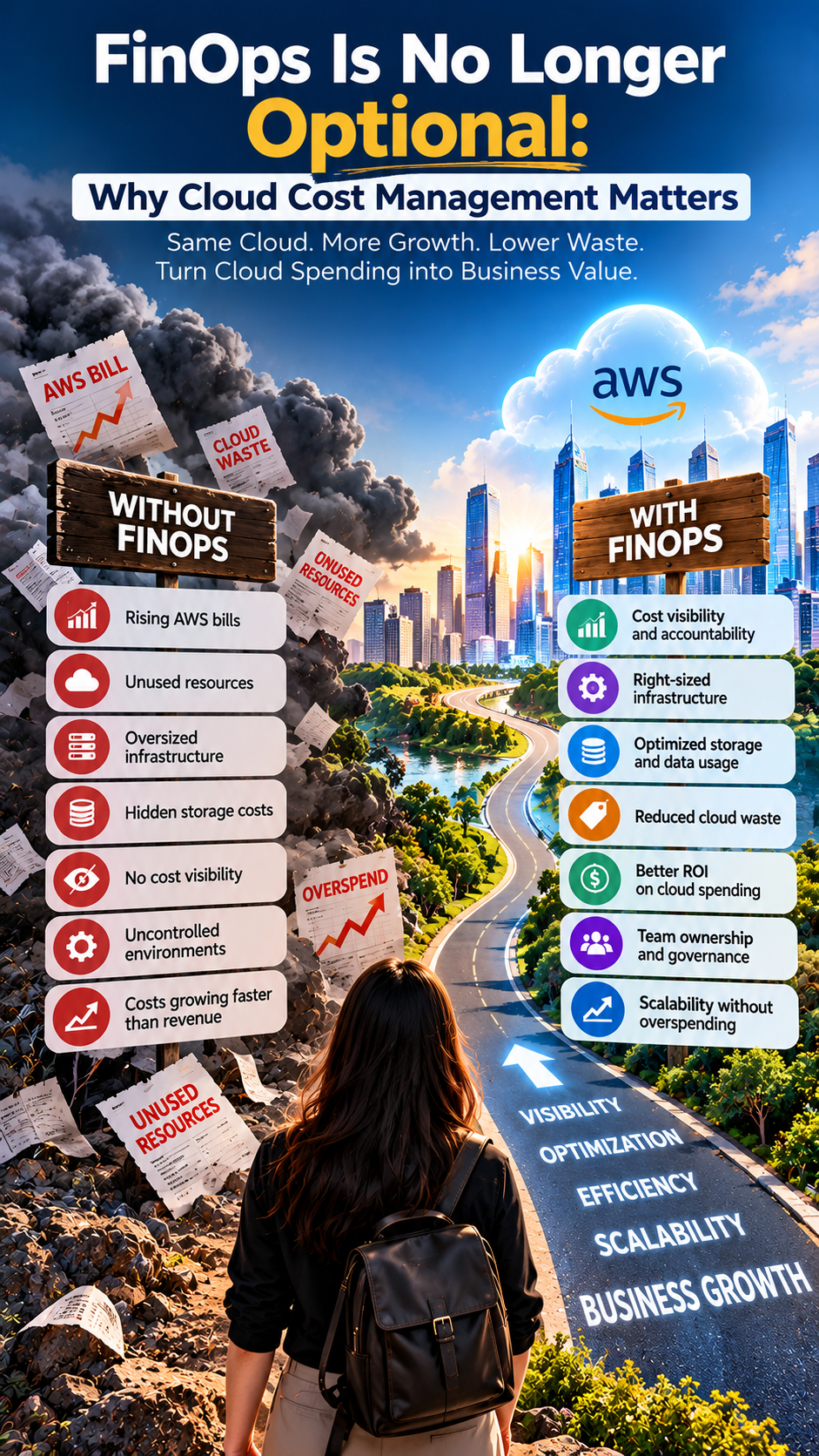
Unused resources.
Overprovisioned infrastructure.
Bad storage policies.
Unnecessary data transfer.
Poor monitoring.
Weak cost controls.
These problems can happen anywhere.
Don't Choose a Cloud. Choose an Architecture.
This is perhaps the biggest lesson.
Cloud providers are tools.
Your architecture is the strategy.
A good architecture should answer:
How will we scale?
How will we secure our data?
How will we recover from failure?
How will we control costs?
How will we support AI?
How will developers deploy?
How will we monitor everything?
Once those questions are answered, choosing between AWS, Azure, and Google Cloud becomes much easier.
Final Thought
AWS isn't going away.
Azure isn't going away.
Google Cloud isn't going away.
And there probably won't be a day when one platform suddenly becomes “the only cloud worth using.”
The cloud market is too important—and the workloads are too different.
So don't choose a provider because someone on LinkedIn said it's the best.
Don't choose one because the logo looks familiar.
And definitely don't choose one because a pricing calculator showed a slightly lower number for one workload.
Choose based on your people, your technology, your data, your customers, and where you want the business to be three years from now.
Because the best cloud isn't AWS.
It isn't Azure.
It isn't Google Cloud.
The best cloud is the one that helps your business move faster without creating unnecessary complexity.
Frequently Asked Questions
Is AWS better than Azure?
Not universally. AWS has a very broad service ecosystem and strong infrastructure flexibility, while Azure can be especially attractive for organizations deeply invested in Microsoft's technology stack.
Is Google Cloud better for AI?
Google Cloud has strong data and AI capabilities, including Vertex AI, but AWS and Azure also have extensive AI offerings. The right choice depends on the models, data, architecture, skills, and business requirements.
Which cloud is best for startups?
There isn't one universal answer. AWS, Azure, and Google Cloud can all support startups. The best option depends on the startup's product, technical team, data requirements, expected growth, and existing technology stack.
Which cloud is cheapest?
There is no single cheapest cloud for every workload. Actual cost depends on architecture, usage, region, storage, networking, discounts, licensing, and operational practices.
Can a company use AWS, Azure, and Google Cloud together?
Yes. A company can use multiple cloud providers, although multi-cloud architectures introduce additional operational, security, networking, and skills complexity.
Did you find this helpful?