When Should You Rebuild Your AWS Architecture? | Savishty
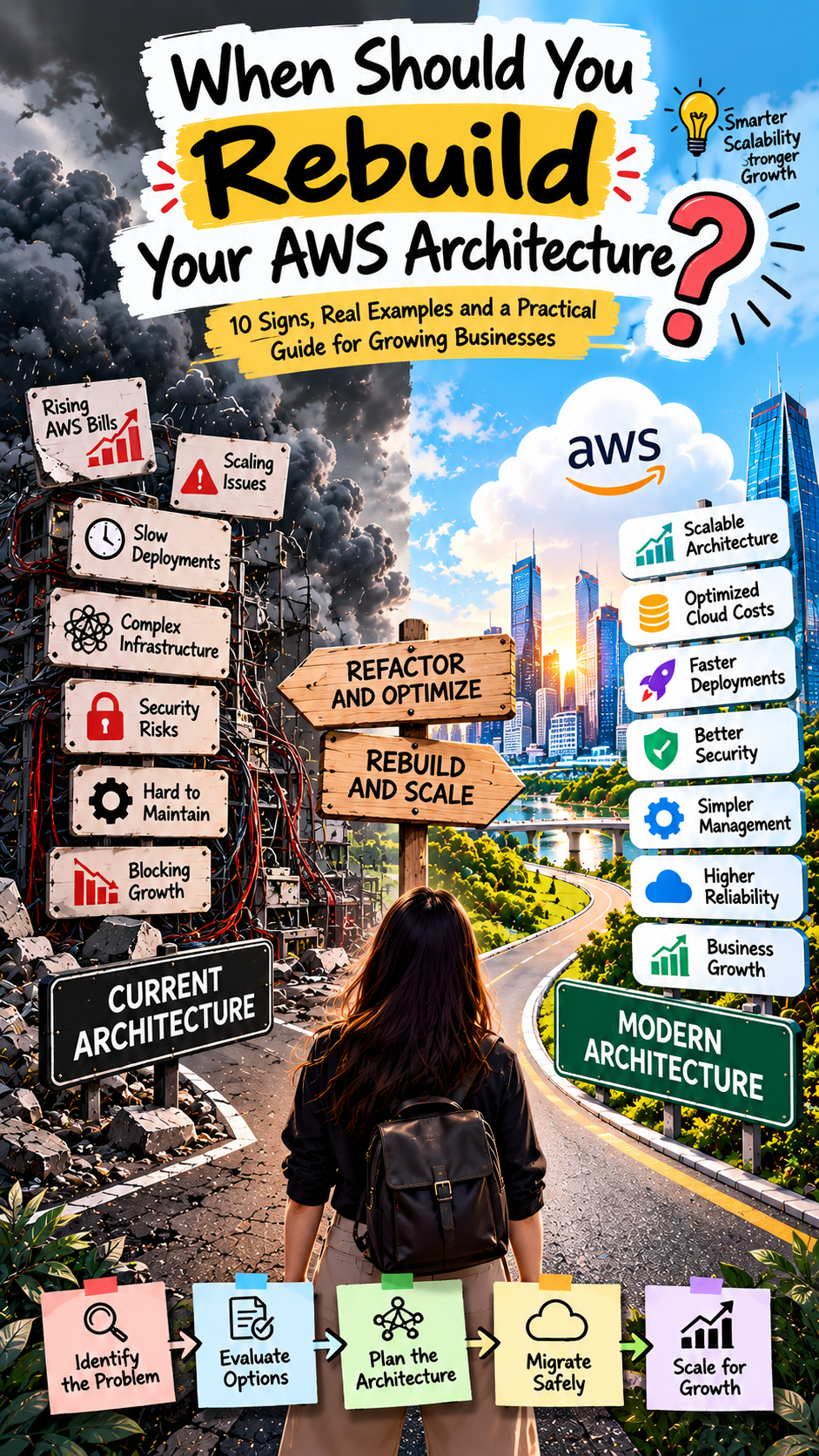
When Should You Rebuild Your AWS Architecture?
Your application is working.
Customers are using it.
Revenue is growing.
So why is your engineering team suddenly talking about rebuilding the architecture?
This is one of the most difficult decisions for a growing technology company.
Because rebuilding an AWS environment isn't like changing a website design.
It can involve databases, APIs, networking, security, deployments, integrations, monitoring, infrastructure and potentially months of engineering effort.
And here's the uncomfortable truth:
Sometimes your architecture doesn't need to be rebuilt.
It simply needs to be improved.
But sometimes, continuing to patch the existing architecture becomes more expensive and risky than rebuilding it.
So how do you know which situation you're in?
---
The First Question: Is Your Architecture Actually the Problem?
Before planning a rebuild, identify the business problem.
Is the application:
- Too slow?
- Frequently unavailable?
- Difficult to scale?
- Too expensive to operate?
- Difficult to deploy?
- Difficult to secure?
- Difficult to maintain?
- Blocking new product development?
If you can't clearly identify the problem, you're probably not ready to rebuild.
Technology teams sometimes rebuild systems because the architecture feels outdated.
But "old" doesn't automatically mean "bad."
A simple architecture that reliably supports the business can be better than a modern architecture that introduces unnecessary complexity.
---
Rebuilding vs Refactoring
These terms are often used interchangeably, but they're very different.
Refactoring
You improve the existing architecture without completely replacing it.
For example:
- Optimize database queries
- Introduce caching
- Improve API design
- Add autoscaling
- Improve monitoring
- Automate deployments
- Separate workloads
- Improve IAM permissions
Rebuilding
You replace significant parts of the existing architecture.
For example:
Old architecture
Monolith → Single database → Manual deployment
becomes:
New architecture
API services → Containers → Managed database → Automated CI/CD → Observability
A rebuild can provide significant benefits.
But it also introduces significant risk.
That's why the decision needs to be based on evidence.
---
10 Signs Your AWS Architecture May Need a Rebuild
1. Scaling Has Become a Constant Problem
Your application works perfectly at normal traffic.
Then traffic increases.
Suddenly:
- APIs slow down
- Database connections max out
- Queues grow
- Servers become overloaded
- Engineers start manually increasing capacity
If scaling problems keep appearing despite targeted optimization, your architecture may have reached a structural limitation.
The important question is:
Which component is actually preventing scale?
Don't rebuild everything because one database is struggling.
Find the bottleneck first.
---
2. Every Change Feels Dangerous
This is a major warning sign.
If developers are afraid to change production because one modification could break unrelated parts of the application, your architecture may have become tightly coupled.
You might hear:
«"Don't touch that service."»
«"Only one person understands this."»
«"We need to deploy everything together."»
«"Changing this API will break three other systems."»
That's not just a code-quality problem.
It can become a business problem.
When architecture prevents teams from moving quickly, technical debt starts affecting product velocity.
---
3. Deployments Are Slow and Risky
Imagine this:
A developer makes a small change.
But deploying it requires:
- Building the entire application
- Testing unrelated components
- Coordinating multiple teams
- Scheduling a deployment window
- Manually changing infrastructure
- Monitoring the release carefully
If a small feature requires a large operational process, your architecture may be creating unnecessary friction.
Modern deployment strategies can introduce:
- CI/CD
- Automated testing
- Infrastructure as Code
- Blue/green deployments
- Canary releases
- Automated rollback
But don't introduce these simply because they're fashionable.
Introduce them because the current process is creating measurable problems.
---
4. Your AWS Bill Doesn't Match Your Business Growth
This is one of the clearest signals.
Suppose:
Customers increase by 30%.
But:
AWS costs increase by 100%.
That doesn't necessarily mean something is wrong.
But it deserves investigation.
Possible causes include:
- Over-provisioned compute
- Inefficient databases
- Excessive data transfer
- Poor storage architecture
- Resources running continuously
- Inefficient application code
- Duplicated infrastructure
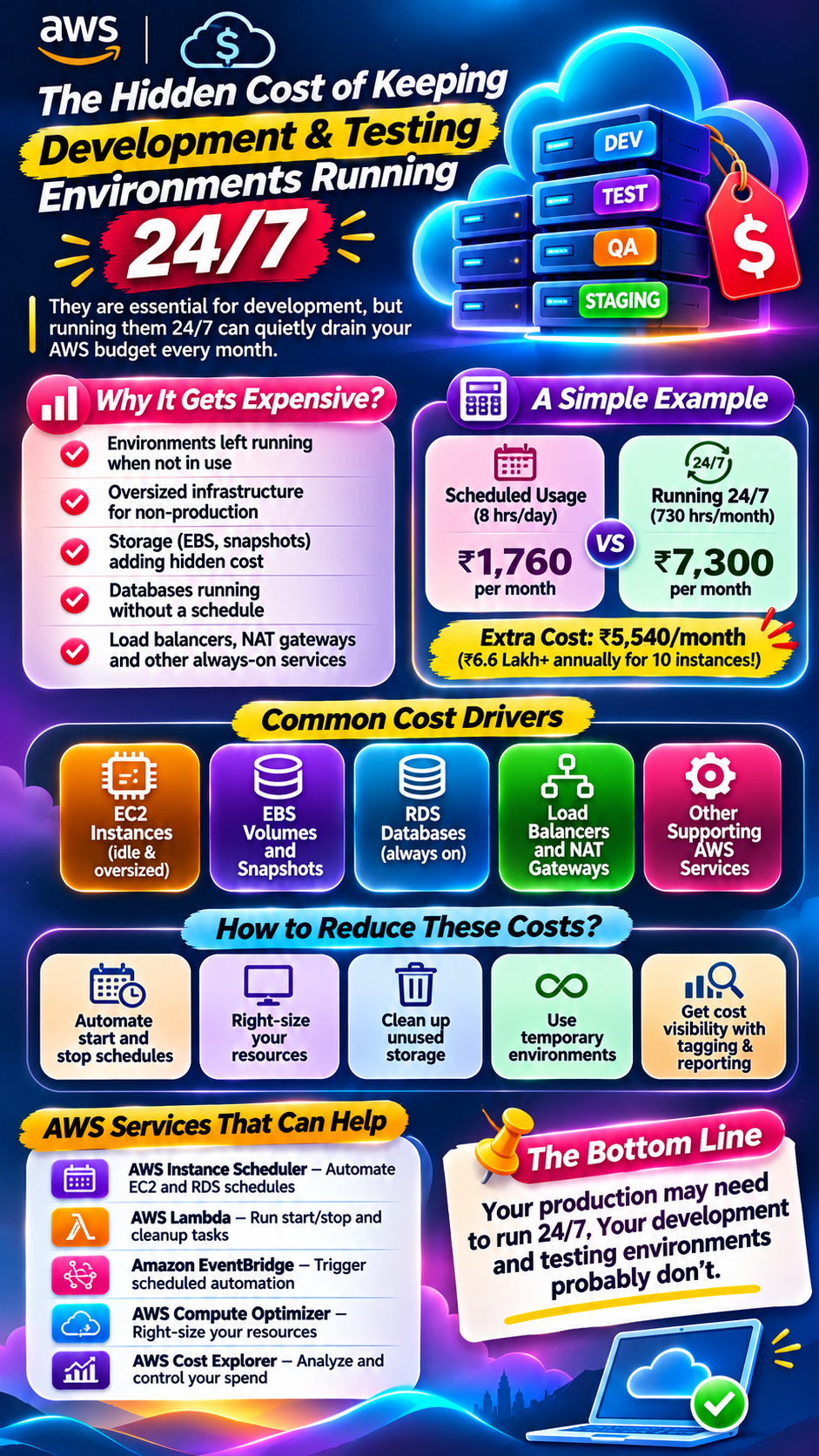
- Uncontrolled development environments
Sometimes cost optimization can solve these problems without a rebuild.
But if the architecture itself creates persistent inefficiency, a redesign may become worthwhile.
---
5. Security Has Become Difficult to Manage
Early-stage applications often evolve quickly.
Security controls may have been added along the way rather than designed from the beginning.
As the business grows, you may discover:
- Too many IAM permissions
- Shared credentials
- Publicly accessible resources
- Weak network segmentation
- Poor secrets management
- Limited logging
- Unclear production access
If security issues are deeply embedded in the architecture, rebuilding specific components may be safer than continuously patching them.
But again, this doesn't automatically mean a complete rebuild.
Start by identifying the highest-risk components.
---
6. Your Database Has Become the Bottleneck
The database often becomes the heart of a growing application.
Eventually, you may see:
- Slow queries
- Connection limits
- Locking problems
- Increasing storage requirements
- Reporting workloads affecting production
- Difficult scaling
Before replacing the database, investigate:
Indexes
Queries
Connection pooling
Caching
Read replicas
Data access patterns
Partitioning
If optimization solves the problem, great.
If the application's data model itself is preventing growth, then a deeper redesign may be justified.
---
7. Your Team Is Spending More Time Managing Infrastructure Than Building Products
This is an underrated architecture signal.
Imagine your engineering team spends significant time:
- Restarting services
- Managing servers
- Fixing deployments
- Manually scaling infrastructure
- Investigating infrastructure issues
- Maintaining custom tooling
instead of building features customers actually want.
At some point, infrastructure becomes an organizational bottleneck.
This is where managed AWS services can become valuable.
Depending on the workload, teams might consider services such as:
- Amazon RDS
- Amazon Aurora
- Amazon ECS
- AWS Fargate
- AWS Lambda
- Amazon S3
- Amazon CloudFront
- Amazon SQS
The objective is not to eliminate engineering responsibility.
It's to reduce unnecessary operational work.
---
8. The Architecture Doesn't Match the Product Anymore
This happens frequently.
Your original architecture was designed for:
10,000 users.
Your product now serves:
1 million users.
Or perhaps the product itself changed.
You started with:
A simple SaaS application.
Now you have:
AI features + real-time processing + analytics + mobile applications + third-party integrations.
The architecture may no longer reflect the workload.
When the product changes significantly, the infrastructure often needs to evolve with it.
---
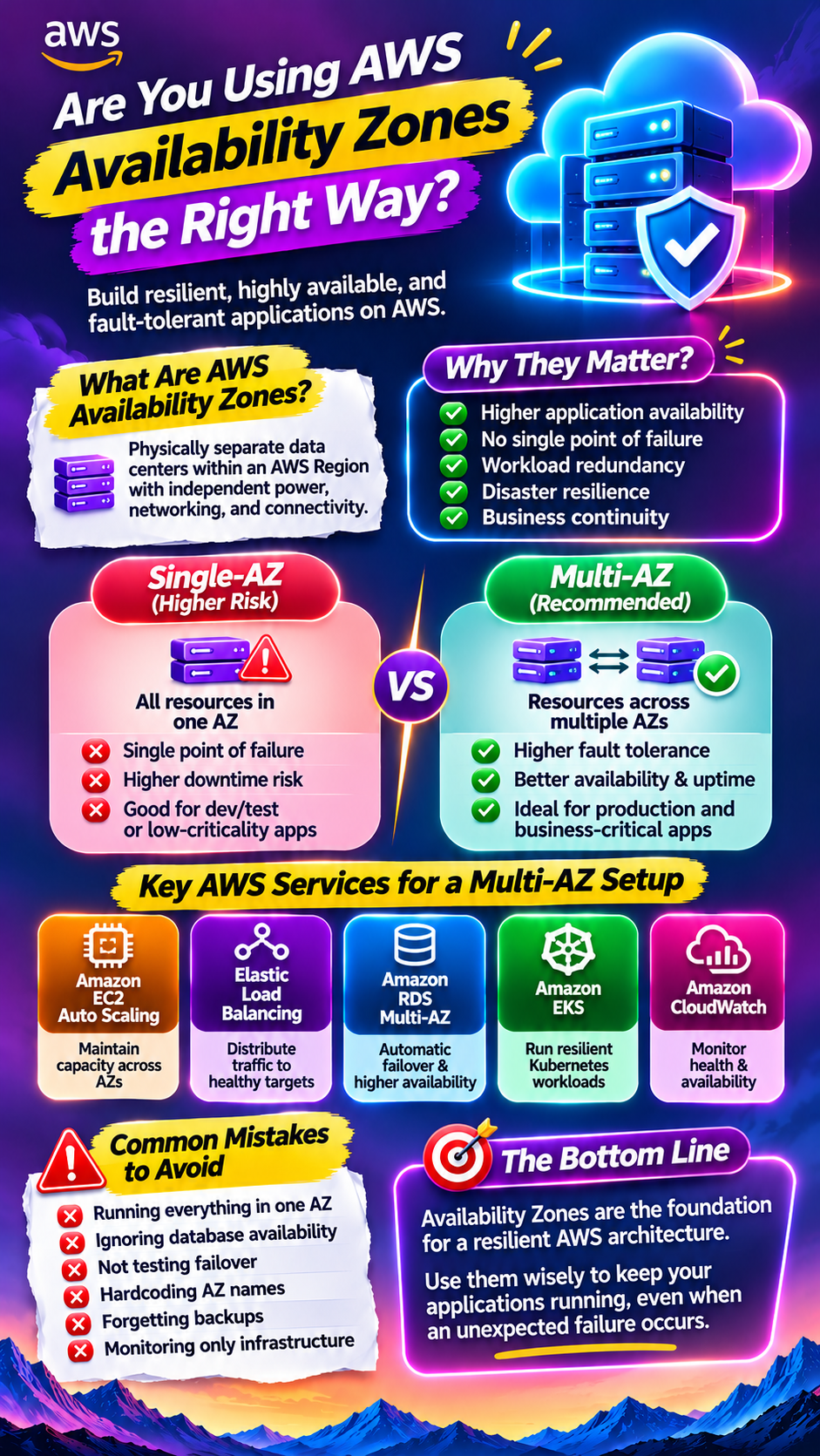
9. One Failure Takes Down Everything
If a single component can bring down the entire application, you may have a resilience problem.
For example:
One database fails → Entire application fails.
One deployment goes wrong → All services go down.
One region experiences an outage → Customers cannot access the product.
The solution isn't always multi-region infrastructure.
Start with the business requirement.
Ask:
How much downtime can we actually tolerate?
Then design your recovery strategy around that requirement.
---
10. Technical Debt Is Slowing Business Growth
Technical debt isn't automatically bad.
Every startup accumulates some.
The problem begins when the debt starts affecting:
Revenue → Product velocity → Reliability → Security → Engineering productivity
At that point, technical debt becomes business debt.
And that's when leadership needs to take architecture seriously.
---
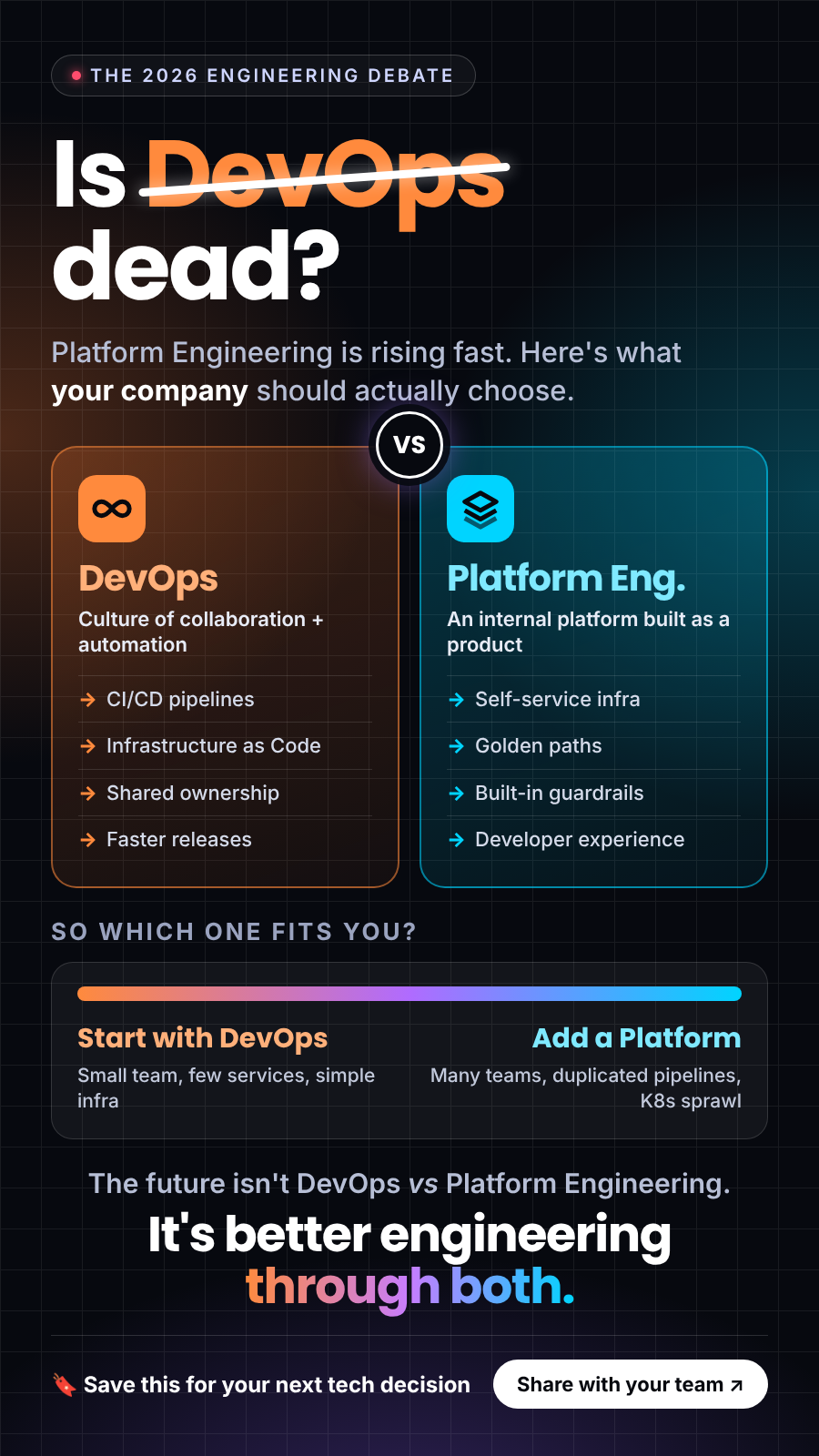
Don't Rebuild Because Kubernetes Looks Cool
This deserves its own section.
A common architecture mistake is:
"We're growing, so let's move everything to Kubernetes."
That's not a strategy.
Kubernetes can be an excellent choice for organizations with the right workloads and operational requirements.
But it also introduces additional complexity.
You may need to manage:
- Cluster configuration
- Networking
- Security
- Deployments
- Observability
- Scaling
- Upgrades
- Access controls
- Operational processes
If your application can run effectively on simpler managed infrastructure, complexity may not provide enough value.
The same principle applies to microservices.
Microservices are not automatically an upgrade from a monolith.
They're a trade-off.
---
The "Strangler" Approach Can Be Better Than a Full Rewrite
One of the biggest mistakes companies make is attempting a complete rewrite.
Imagine replacing:
100% of the existing application
in one massive project.
That's risky.
A better approach can be incremental modernization.
For example:
Step 1
Keep the existing application running.
Step 2
Identify one problematic component.
Step 3
Build a new service around that component.
Step 4
Move traffic gradually.
Step 5
Monitor the new architecture.
Step 6
Repeat.
This approach reduces the blast radius.
Instead of betting the business on one massive migration, you modernize the architecture piece by piece.
---
A Better AWS Rebuild Framework
Before rebuilding, answer these seven questions.
1. What problem are we solving?
Be specific.
"Architecture is old" isn't enough.
2. What is the current bottleneck?
Database?
Compute?
Network?
Deployment?
Security?
3. Can we fix it without rebuilding?
Try the smallest effective change first.
4. What will the new architecture improve?
Define measurable outcomes.
5. What will the migration cost?
Consider:
- Engineering time
- Cloud costs
- Downtime risk
- Training
- Operational complexity
6. What could go wrong?
Identify migration risks before starting.
7. How will we know the rebuild worked?
Define metrics.
For example:
API latency ↓
Deployment time ↓
AWS cost per customer ↓
Incident frequency ↓
Recovery time ↓
Developer productivity ↑
---
What Should Your New Architecture Optimize For?
A modern AWS architecture shouldn't simply be "more modern."
It should improve specific business outcomes.
Reliability
Can customers depend on the system?
Scalability
Can infrastructure handle growth?
Security
Can sensitive resources be protected effectively?
Cost efficiency
Does infrastructure spending scale reasonably with business growth?
Developer velocity
Can engineers ship safely and quickly?
Observability
Can the team understand what is happening inside the system?
Maintainability
Can new engineers understand and operate the platform?
These are better architecture goals than simply saying:
"Let's move to microservices."
---
A Simple Decision Matrix
Situation| Rebuild?
One slow API| Usually no
One oversized database| Usually no
High AWS bill| Investigate first
Manual deployments| Refactor/automate first
Poor monitoring| Improve observability first
Security issue in one component| Targeted redesign
Architecture blocks scaling| Possibly
Severe technical debt| Possibly
Product has completely changed| Likely
Core architecture prevents growth| Strong rebuild candidate
The key word is "possibly."
Architecture decisions need context.
---
The Cost of Not Rebuilding
There is another side to this decision.
Not rebuilding has a cost too.
You may eventually pay through:
- Engineering slowdown
- Customer churn
- Downtime
- Security incidents
- Cloud waste
- Slower product releases
- Hiring difficulties
- Operational burnout
That's why the decision shouldn't be:
"Can we afford to rebuild?"
It should be:
"Can we afford not to fix the problem?"
---
The Best Time to Rebuild Isn't When Everything Is Broken
Waiting until the system completely collapses is usually too late.
A better time to consider architectural change is when you have clear evidence that the current design is becoming a constraint, but still have enough stability to migrate safely.
That means watching the signals early.
Monitor:
- Traffic growth
- AWS spending
- Application latency
- Error rates
- Database utilization
- Deployment frequency
- Deployment failures
- Incident frequency
- Developer productivity
- Security findings
Your metrics should tell you when architecture needs to evolve.
---
Final Thought
You don't rebuild an AWS architecture because it looks old.
You rebuild it because the current architecture is preventing the business from moving forward.
Sometimes the answer is a complete redesign.
Sometimes it's a database optimization.
Sometimes it's better monitoring.
Sometimes it's moving one workload to a managed service.
And sometimes it's simply cleaning up years of accumulated technical debt.
The smartest architecture teams don't ask:
"What's the newest AWS architecture?"
They ask:
"What architecture gives our business the best combination of reliability, scalability, security, cost efficiency and engineering velocity?"
Because the goal isn't to build the most sophisticated cloud environment.
The goal is to build an environment that helps the business grow.
Did you find this helpful?