From Chatbots to AI Agents: What's Coming Next for AWS? | Savishty
The Chatbot Was Just the Beginning
Remember when getting a chatbot on your website felt like a big deal?
A customer typed a question.
The bot understood it.
It replied.
Everyone was impressed.
Then we started asking a different question:
"What if the AI could actually do something?"
Not just tell a customer how to change an address.
Actually change it.
Not just explain why an invoice is overdue.
Actually send the reminder.
Not just tell a sales executive which leads look promising.
Actually update the CRM, schedule a meeting, and prepare the follow-up.
That's the shift happening now.
We're moving from AI that talks to AI that acts.
And AWS is building a significant part of the infrastructure behind that shift.
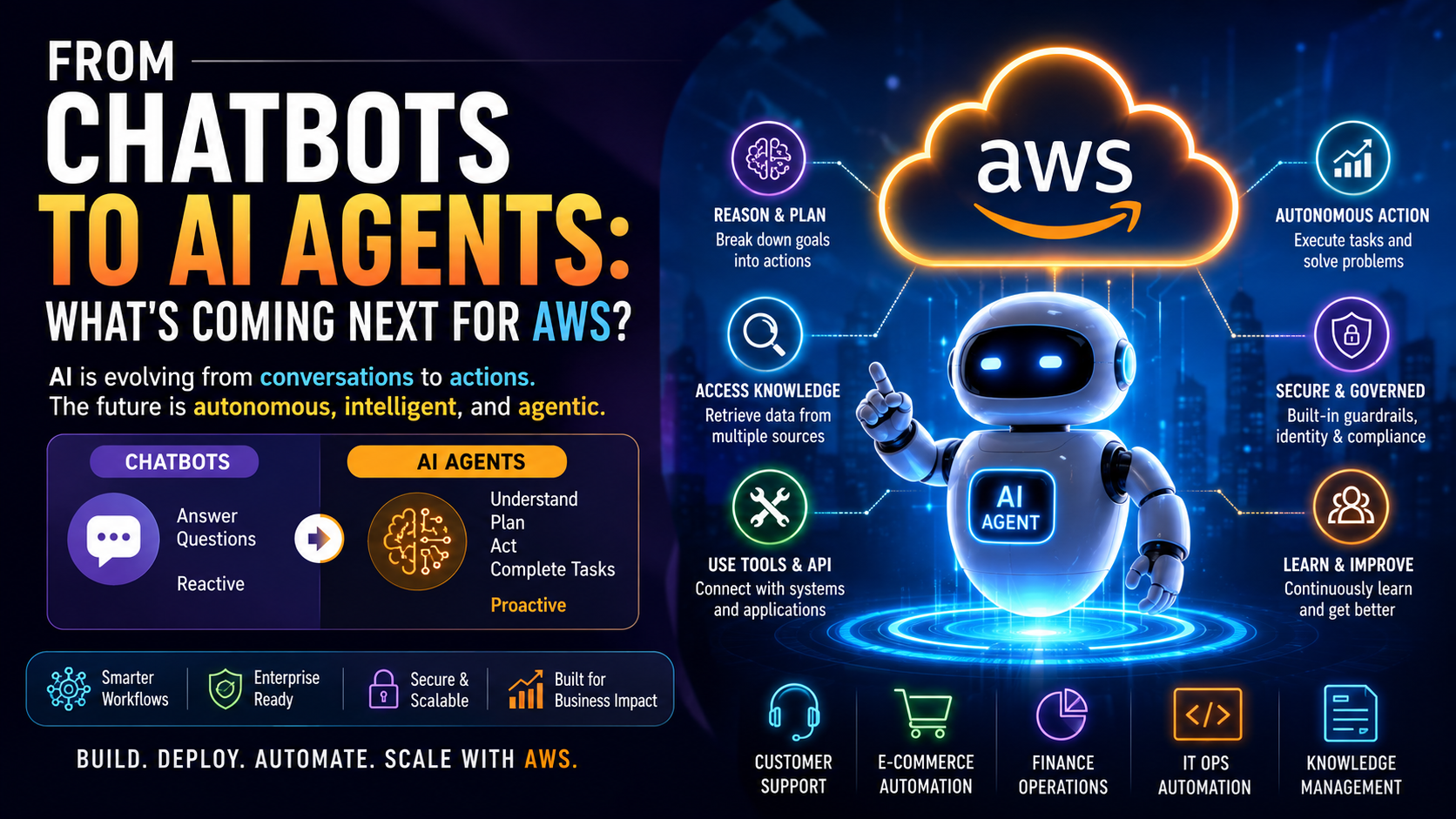
Chatbots Answer. Agents Act.
A chatbot is usually waiting for you.
You ask.
It responds.
An AI agent works differently.
You give it a goal.
It figures out what needs to happen.
It can reason through multiple steps, use tools, access information, call APIs, and continue working toward the outcome.
Think about the difference:
Chatbot:
"Your order is delayed by two days."
AI agent:
"Your order is delayed by two days. I've checked the latest shipping information, contacted the delivery system, updated the expected date, and sent you a notification."
That's a completely different experience.
The second one isn't simply answering a question.
It's completing a task.
AWS describes agentic systems as applications that can connect models with tools, data, and actions to automate multi-step tasks.
Why This Changes the Cloud Conversation
Here's the part many businesses are going to discover the hard way.
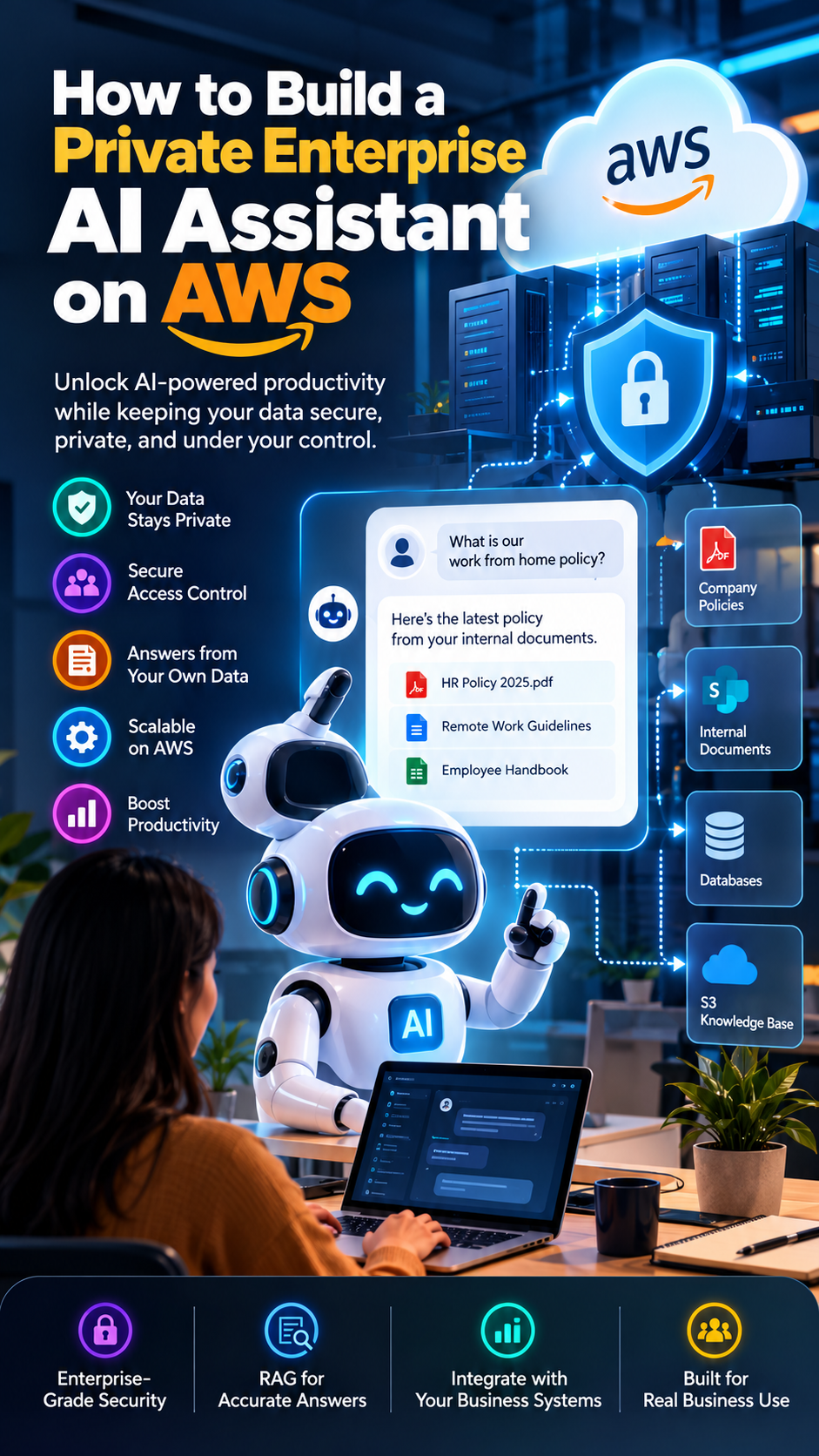
An AI agent needs more than a model.
It needs an environment where it can:
Access company information
Remember relevant context
Call APIs
Use business tools
Run code safely
Authenticate securely
Make decisions
Be monitored
Handle failures
Scale when usage increases
Suddenly, AI becomes an infrastructure problem too.
And that's where cloud platforms become extremely important.
AWS Is Moving Beyond "AI Model Hosting"
AWS has been building an ecosystem around generative AI for some time.
Amazon Bedrock gives businesses access to foundation models and tools for building generative AI applications.
But the agent conversation is going further.
AWS now positions Amazon Bedrock AgentCore as a platform for building, deploying, and operating AI agents securely at scale. AgentCore is designed to work with different models and agent frameworks rather than forcing developers into a single stack.
That's important because businesses don't want to rebuild their entire technology strategy every time a new model becomes available.
They want flexibility.
So What Could an AWS-Powered Agent Actually Do?
Let's move away from theory.
Imagine a company's sales agent.
A salesperson says:
"Find our highest-value prospects from last month and prepare a follow-up plan."
The agent could potentially:
Retrieve sales data.
Analyze customer activity.
Identify high-value prospects.
Check previous interactions.
Research relevant information.
Draft personalized messages.
Update the CRM.
Ask the salesperson for approval before sending anything.
That's not a chatbot.
That's an AI worker assisting with a workflow.
And the same idea can be applied across departments.
Customer Support
Instead of simply answering:
"How do I reset my account?"
an agent could potentially verify the customer, retrieve account information, check relevant policies, guide the user through the process, and escalate the issue when human intervention is required.
The goal isn't to eliminate people.
It's to eliminate unnecessary steps.
Finance
Imagine an agent reviewing invoices.
It could compare invoices against purchase orders, identify unusual amounts, flag exceptions, prepare summaries, and route questionable transactions to a human.
The finance team spends less time searching for problems and more time deciding what to do about them.
IT Operations
This is where things get particularly interesting.
An AI agent could monitor systems, investigate alerts, check logs, identify likely causes, and recommend or execute predefined remediation steps.
Instead of an engineer waking up at 2 AM to investigate an alert manually, an agent could do the first round of investigation before escalating the issue.
That's potentially a very different IT operating model.
Research and Knowledge Work
Ask an AI assistant:
"Summarize our company's position on this market and compare it with the latest public information."
A basic chatbot may rely on information it already has.
An agent can potentially retrieve internal knowledge, access approved external sources, analyze information, and produce a structured result.
AWS has been adding capabilities to AgentCore around organizational, web, and other knowledge sources, along with tools for evaluating and improving agents in production.
That takes AI from "generate an answer" toward "complete a research task."
But Here's the Catch: More Autonomy Means More Risk
Giving AI access to your company's systems sounds exciting.
It should also make you slightly nervous.
And that's healthy.
What happens if an agent:
Sends the wrong email?
Changes the wrong customer record?
Uses an unauthorized API?
Makes an expensive series of calls?
Accesses information it shouldn't?
Gets stuck in a loop?
Makes a decision nobody can explain?
A chatbot giving you a bad answer is frustrating.
An agent taking the wrong action can become a business incident.
That's why security, identity, permissions, observability, evaluation, and human oversight become central to agentic AI.
AWS itself has highlighted governance, security, evaluation, and observability as key parts of operating agents in production.
The New Question Isn't "Can AI Do It?"
We're entering a stage where that question isn't particularly useful anymore.
A better question is:
"Should we let AI do it?"
And then:
"Under what conditions?"
For example:
AI can draft an email.
Human approves it.
AI can recommend a refund.
Human approves it.
AI can identify a suspicious transaction.
Human investigates it.
AI can restart a service.
Only if predefined conditions are satisfied.
This creates a useful middle ground between completely manual workflows and uncontrolled autonomy.
AgentCore Is Pointing Toward This Future
AWS's current direction with Amazon Bedrock AgentCore is particularly interesting because the focus isn't only on creating an agent.
It's also on everything required to operate one.
AgentCore includes capabilities around runtime, memory, tools, identity, observability, and other production concerns. AWS also describes compatibility with multiple frameworks and model providers.
That matters because the hardest part of AI isn't always building the first demo.
The demo can be surprisingly easy.
Production is the hard part.
And AI Agents Are Starting to Touch Transactions
Here's where things could get even more interesting.
AWS has introduced AgentCore Payments capabilities aimed at enabling agents to participate in transactions, including interactions involving payment infrastructure.
Think about the implication.
Today:
You → Website → Product → Checkout → Payment
Tomorrow, potentially:
Your AI agent → Finds product → Evaluates options → Makes decision → Completes transaction
That means businesses may eventually need to design their products not only for human customers, but for software agents acting on behalf of humans.
That's a much bigger shift than another chatbot upgrade.
What Does This Mean for Startups?
For startups, this could be a huge opportunity.
You don't necessarily need to build an enormous AI research team.
You can combine:
Cloud infrastructure + foundation models + business data + APIs + agent frameworks
and create applications that perform real work.
A small team could potentially build an AI-powered operations assistant that would previously have required an entire software product and a large operations team.
That's one reason agentic AI is attracting so much attention.
It changes the economics of software.
But Don't Turn Everything Into an Agent
This is probably the most important advice.
Not every workflow needs an autonomous AI agent.
If a simple API call solves the problem, use the API.
If a rule works perfectly, use the rule.
If a human decision is critical, keep the human involved.
AI agents make the most sense when the problem involves multiple steps, changing information, judgment, and interaction with different tools or systems.
The goal isn't maximum autonomy.
The goal is useful autonomy.
What Comes Next for AWS?
If current developments are any indication, the next phase of AWS's AI story is likely to focus less on simply providing access to models and more on helping businesses operate AI systems that can actually get work done.
Expect the conversation to increasingly revolve around:
AI agents
Multi-agent workflows
Persistent memory
Tool use
Enterprise knowledge
AI security
Agent observability
Evaluation
Human-in-the-loop controls
AI-to-AI and AI-to-business interactions
AWS is already building in these directions through Bedrock AgentCore and related services.
The Biggest Change May Not Be the Technology
It may be how we think about software.
For decades, we built software around buttons.
Click here.
Submit this.
Search that.
Run this report.
AI agents introduce another possibility:
"Here's what I need. Figure out the steps."
That's a very different interface.
And if it works reliably, it could change how employees interact with enterprise software.
Instead of learning ten different applications, an employee might increasingly interact with an AI layer that works across them.
Final Thought
The chatbot era taught us that machines can have conversations.
The agent era is asking something much bigger:
Can machines actually get work done?
AWS is building infrastructure to help businesses explore that question—from models and data to tools, runtimes, security, observability, and production operations.
But the winners won't be the companies that give AI the most freedom.
They'll be the companies that give AI the right freedom.
Enough autonomy to move work forward.
Enough controls to keep the business safe.
And enough human judgment to know when the machine should stop and ask.
The future of AI may not be a smarter chatbot sitting on your website.
It may be a digital workforce quietly working behind the scenes.
And we're only beginning to see what that looks like.
Did you find this helpful?