How to Build Infrastructure for Your First 1,000 Customers and Your Next 1 Million | Savishty
Your First 1,000 Customers Are Exciting.
Your Next 1 Million Are a Different Problem.
The first 10 customers are usually the fun part.
You know who they are.
You probably know what they need.
If something breaks, someone on the team can jump in and fix it.
Then you reach 100.
Things get a little busier.
At 1,000?
Now you're starting to notice things.
The database is getting heavier.
Support tickets are increasing.
Your application occasionally slows down.
Your cloud bill is no longer something the finance team ignores.
And then someone says:
"What happens if we get 100,000 customers?"
That's when infrastructure stops being a technical detail.
It becomes a growth strategy.
Don't Build for 1 Million Customers on Day One
This sounds obvious.
Yet startups make this mistake all the time.
They hear "scalability" and immediately start designing infrastructure for millions of users.
Multiple regions.
Complex microservices.
Kubernetes clusters.
Distributed databases.
Advanced caching.
Dozens of cloud services.
Six months later, they've spent a fortune building infrastructure for customers they don't have.
There's a better approach.
Build for today.
Design for tomorrow.
Don't pay for tomorrow until tomorrow arrives.
That's one of the biggest advantages of cloud infrastructure.
You don't need to own the infrastructure for 1 million customers before you have your first 1,000.
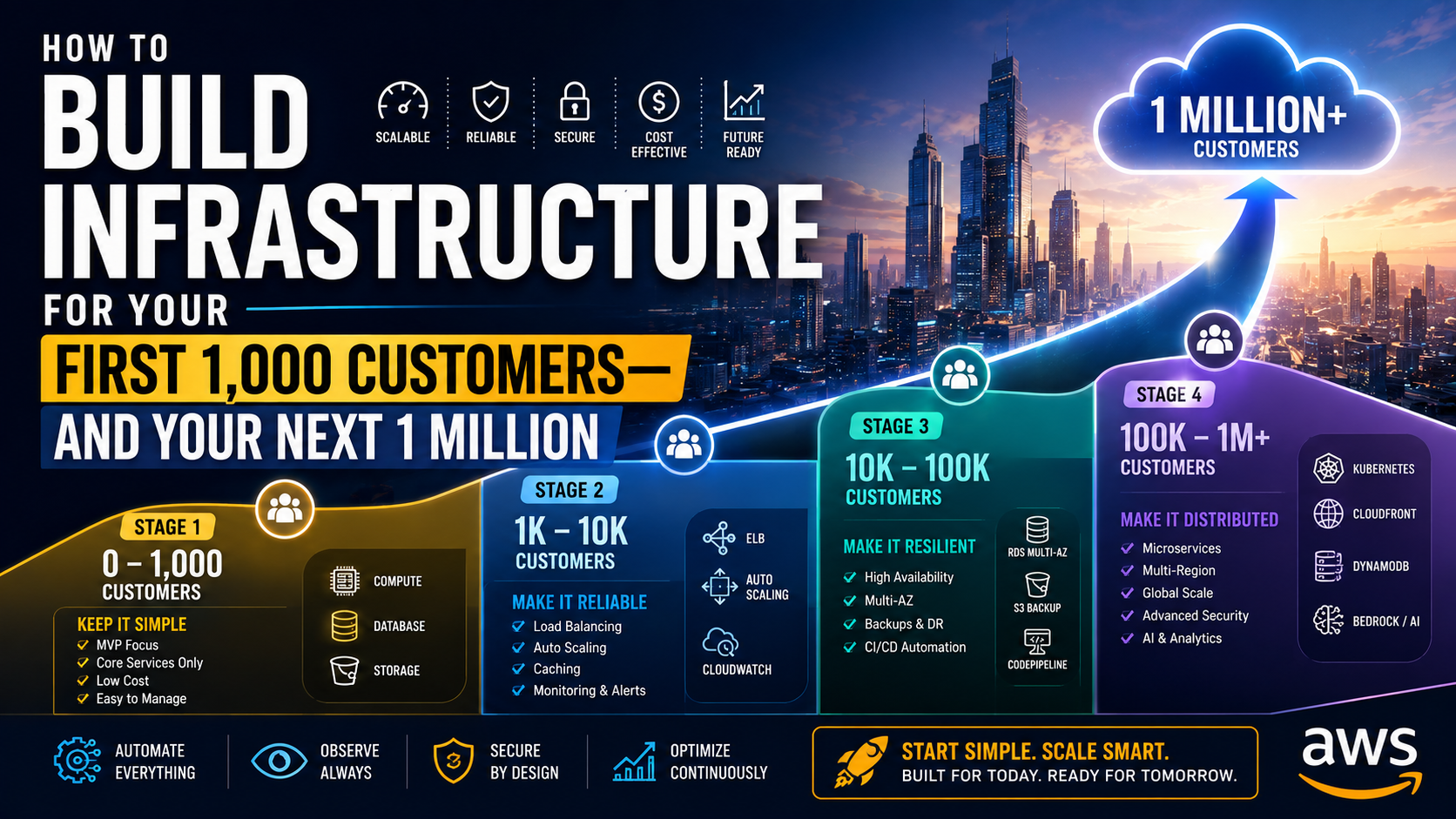
Stage 1: Your First 1,000 Customers
At this stage, your biggest problem isn't scale.
It's finding product-market fit.
Your infrastructure should be:
Simple
Secure
Observable
Affordable
Easy for a small team to manage
You don't need 50 services.
You need the right few.
A startup might begin with something as straightforward as:
Application → Compute → Database → Storage
On AWS, that could mean services such as Amazon EC2 or a container platform for compute, Amazon RDS for relational databases, and Amazon S3 for object storage.
The exact architecture depends on the product.
The principle doesn't.
Keep the architecture understandable.
If only one engineer understands how your entire platform works, you've created a future problem.
Your First Infrastructure Rule: Don't Overbuild
Imagine you're building a restaurant.
You have 20 customers a day.
Would you build a kitchen designed to serve 10,000 people?
Probably not.
You'd build a kitchen that works well today—and make sure you have a plan for expanding it.
Cloud infrastructure should work the same way.
At the beginning, optimize for:
Speed of development.
Reliability.
Security.
Cost visibility.
Ease of maintenance.
Not architectural complexity for its own sake.
Stage 2: 10,000 Customers Changes the Conversation
Now things start getting interesting.
Your user base is growing.
Your application is receiving more traffic.
Your database is handling more queries.
Your team is deploying more frequently.
And suddenly, one server isn't enough.
This is where you start thinking seriously about:
Load balancing
Instead of sending every request to one application server, traffic can be distributed across multiple instances.
Auto scaling
Resources can increase or decrease according to demand.
Caching
Frequently requested information can be served faster without repeatedly hitting your database.
Monitoring
You need to know when performance starts degrading—not after customers start complaining.
This is where services such as Amazon CloudWatch can become increasingly valuable.
Stage 3: 100,000 Customers
At 100,000 customers, your infrastructure isn't just supporting the product.
It's becoming part of the product.
A small problem can affect thousands of people.
You need to start asking different questions.
What happens if our database fails?
What happens if traffic suddenly increases 10x?
What happens if one availability zone becomes unavailable?
How quickly can we recover?
Can we deploy without taking the application offline?
Who gets paged when something breaks at 3 AM?
These aren't questions you can postpone forever.
This Is Where Observability Becomes Your Friend
There's a big difference between:
"The application is slow."
and:
"API latency increased 42% after the latest deployment, database CPU is normal, but one downstream service is returning elevated error rates."
The second statement gives your engineering team somewhere to start.
Monitoring, logs, metrics, tracing, and alerts become increasingly important as systems grow.
You don't want your customers to be your monitoring system.
Stage 4: 1 Million Customers
Now we're talking about a different class of infrastructure.
At this point, your architecture may need to support:
Large traffic volumes
Multiple application services
Distributed workloads
High availability
Automated deployments
Advanced security controls
Disaster recovery
Data analytics
Global users
Strong cost governance
But here's the important part:
You shouldn't suddenly build this architecture when you hit 1 million.
You should gradually grow toward it.
That's the whole point.
Design for Scale Without Designing Everything for Scale
There's a subtle difference.
Designing for scale means making architectural decisions that won't trap you later.
Designing everything for maximum scale means spending money and engineering time on problems you may never have.
For example:
You don't need a globally distributed database when 99% of your customers are in one region.
You might not need a complex multi-region architecture when your business can tolerate some downtime.
You may not need Kubernetes because everyone on LinkedIn says "Kubernetes."
Technology should solve a business problem.
Not create one.
Your Database Will Probably Become the Bottleneck
This is something many growing startups discover.
Applications can often be scaled horizontally relatively easily.
Databases are different.
As customers increase, so does:
Read traffic.
Write traffic.
Data volume.
Queries.
Transactions.
Eventually, your database becomes one of the most important pieces of the architecture.
This is where techniques such as:
Read replicas
Caching
Query optimization
Database indexing
Partitioning
Connection pooling
Appropriate database selection
can become critical.
The lesson?
Don't just watch your application servers.
Watch your data layer.
Your Cloud Bill Will Grow Too
Here's another reality founders discover.
More customers usually mean more revenue.
But they also mean more infrastructure usage.
More compute.
More storage.
More data transfer.
More database activity.
More monitoring.
More logs.
More backups.
If you aren't watching your cloud costs, growth can create an unpleasant surprise.
This is why cloud cost optimization shouldn't start when the bill becomes a crisis.
Start early.
Set budgets.
Monitor usage.
Remove unused resources.
Choose appropriate instance sizes.
Review storage policies.
Understand which workloads are actually driving costs.
The goal isn't to spend as little as possible.
It's to make sure every rupee spent on infrastructure contributes to the business.
Security Cannot Be a “Later” Problem
There's a dangerous startup mindset:
"We'll worry about security when we're bigger."
Unfortunately, attackers don't always wait for your Series B.
Even a small startup can hold valuable:
Customer information
Payment data
Credentials
Intellectual property
Business documents
Source code
Build security into the foundation.
Use strong identity controls.
Enable MFA.
Follow least privilege.
Separate environments.
Encrypt sensitive data.
Monitor access.
Back up critical systems.
Security gets harder to fix after the system has grown.
What About AI?
Here's where modern startup infrastructure gets even more interesting.
Your first 1,000 customers might use a traditional SaaS application.
Your next 100,000 might expect AI features.
Your next 1 million might generate enormous amounts of AI-related data and activity.
AI can introduce new infrastructure requirements around:
Model inference
Data pipelines
Vector search
GPU/accelerator workloads
AI observability
Data security
Model costs
AWS services such as Amazon Bedrock can help businesses integrate generative AI capabilities without building foundation models from scratch.
But again:
Don't add AI because it's fashionable.
Add it because it solves a customer problem.
The Architecture Should Evolve With the Business
Here's a simple way to think about it:
1–1,000 customers
Keep it simple.
Focus on product-market fit.
1,000–10,000
Make it reliable.
Improve monitoring, scaling, backups, and deployment.
10,000–100,000
Make it resilient.
Reduce single points of failure and improve automation.
100,000–1 million
Make it distributed where necessary.
Think carefully about performance, availability, data architecture, security, and global delivery.
The exact numbers aren't universal.
Your application's traffic patterns matter more than the customer count.
A social platform with 10,000 extremely active users may need more infrastructure than a B2B application with 100,000 customers who log in once a month.
Users aren't infrastructure metrics. Workload is.
The Secret Weapon: Automation
As your startup grows, manual processes become dangerous.
If deployment requires someone to manually copy files, you're going to have problems.
If scaling requires someone to wake up and add servers, you're going to have problems.
If backups depend on someone remembering to run them, you're going to have problems.
Automate wherever repetition exists.
Infrastructure as Code.
Automated deployments.
Automated testing.
Automated backups.
Automated scaling.
Automated alerts.
The goal isn't to remove humans.
It's to stop highly skilled humans from repeatedly doing work a machine can handle.
Don't Forget the People Behind the Infrastructure
There's another scalability problem startups often ignore.
The team.
A system that requires five engineers to operate at 1,000 customers may become impossible at 1 million.
Your infrastructure should become more automated as your customer base grows.
Good architecture isn't just about machines.
It's about how much human effort is required to keep those machines running.
The Real Goal Isn't 1 Million Customers
Here's the twist.
You shouldn't build infrastructure simply because you want to say:
"We can support 1 million users."
You should build infrastructure that allows your business to say:
"If we get 1 million users, we're ready."
There's a difference.
One is an engineering vanity metric.
The other is business resilience.
Final Thought
Your first 1,000 customers need a product that works.
Your next 100,000 need a platform they can trust.
Your next 1 million need infrastructure that can scale without the company collapsing under its own success.
You don't need to build the infrastructure for 1 million customers today.
But you do need to avoid architectural decisions that make tomorrow unnecessarily painful.
Start simple.
Automate early.
Monitor everything important.
Secure the foundation.
Watch your costs.
And let the architecture evolve as the business earns the right to need it.
Because the best infrastructure isn't the most complicated one.
It's the one that lets your business grow without getting in its own way.
Frequently Asked Questions
How should a startup build infrastructure for its first 1,000 customers?
Start with a simple, secure, observable architecture. Focus on reliable application hosting, database management, storage, backups, monitoring, and automated deployment rather than building unnecessary complexity.
When should a startup start thinking about scalability?
From day one but that doesn't mean building for 1 million users immediately. Make early choices that allow the system to evolve without expensive rewrites.
Is AWS suitable for startups?
AWS offers a wide range of infrastructure, database, storage, security, monitoring, serverless, and AI services that can support startups as they grow. The right architecture depends on the product and workload.
How can startups control cloud costs while scaling?
Monitor usage from the beginning, remove unused resources, right-size workloads, use appropriate pricing models, establish budgets and alerts, and regularly review architecture and storage.
Does reaching 1 million customers require a completely different architecture?
Not necessarily. The architecture should evolve gradually based on actual traffic, data volume, availability requirements, geographic distribution, and application behavior. A million low-activity users can create very different infrastructure requirements from a smaller but extremely active user base.
What is the biggest infrastructure mistake startups make?
Overengineering too early or waiting too long to fix obvious bottlenecks.
The sweet spot is building something simple today that doesn't make tomorrow unnecessarily difficult.
Did you find this helpful?