India's AI Story Just Got Bigger Than Technology | Savishty
For a long time, India's role in the AI conversation felt fairly predictable.
We were the country adopting new tools, experimenting with use cases, and providing the talent powering global innovation.
But that story seems to be changing.
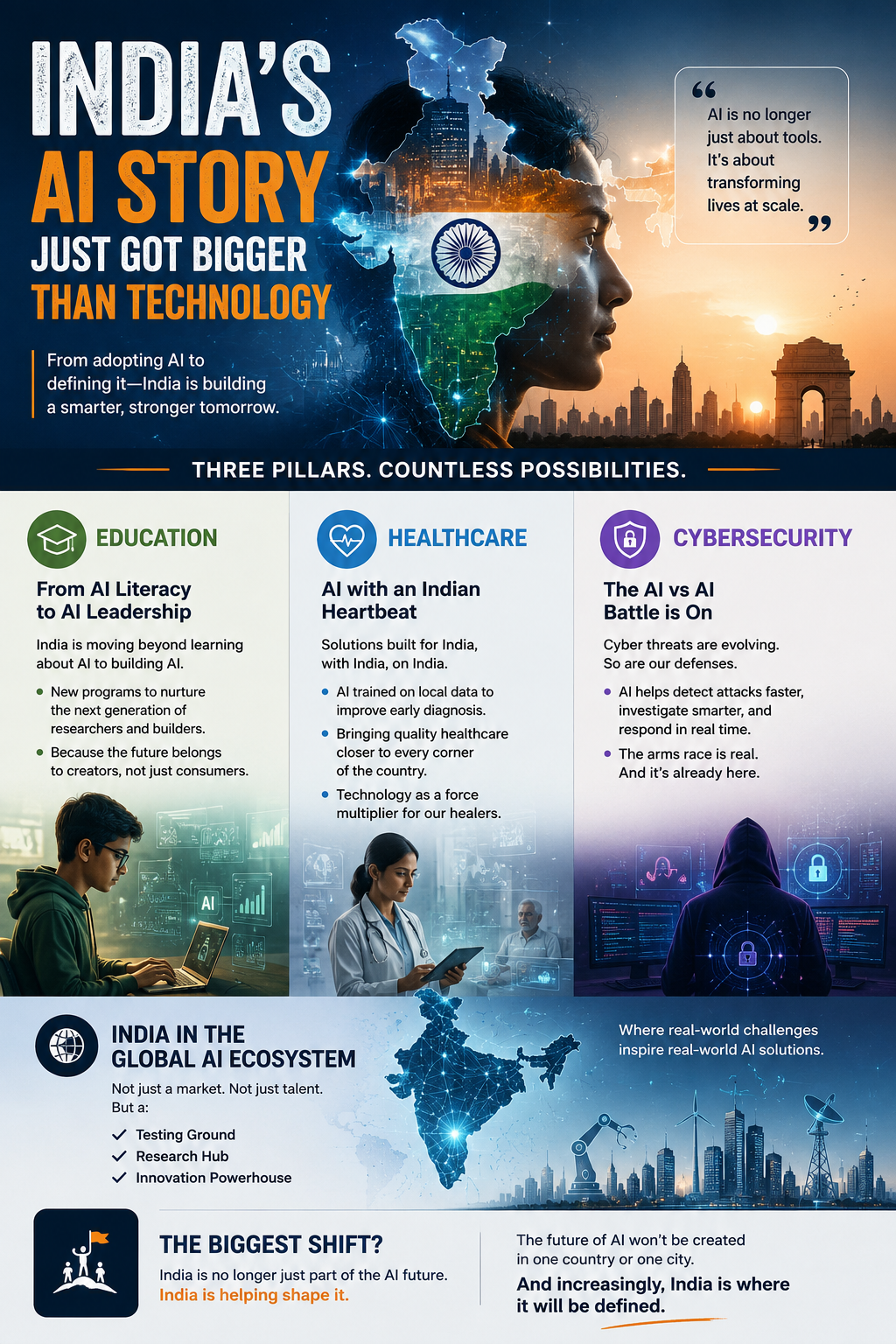
The latest announcements made at Google I/O Connect India weren't really about launching another chatbot or adding another AI feature to an existing product. They pointed to something much larger — an attempt to embed AI into some of the systems that affect everyday life the most.
Education.
Healthcare.
Cybersecurity.
Three areas that touch almost every person in the country.
The education initiatives stood out immediately.
India has spent years talking about preparing students for an AI-driven future, but teaching people how to use AI and teaching people how to build AI are very different things. The new programs announced aim to move beyond simple AI literacy and focus on developing the next generation of researchers, developers, and builders.
That shift matters.
Countries that create technology tend to shape the future more than countries that simply consume it.
Healthcare may be an even bigger opportunity.
India's healthcare challenges are unique in scale, language diversity, and accessibility. Solutions designed for hospitals in Silicon Valley don't always translate well to rural clinics or overcrowded urban hospitals.
AI trained on Indian data and Indian healthcare realities has the potential to improve early diagnosis, reduce pressure on medical professionals, and make quality healthcare more accessible in places where specialists are difficult to reach.
Of course, technology alone won't solve these problems.
But it can become a force multiplier for the people already trying to solve them.
The cybersecurity announcements were another reminder of how quickly the AI landscape is evolving.
For years, cybersecurity was a battle between people.
Today it's increasingly becoming AI versus AI.
Attackers are using automation and intelligent systems to scale threats faster than ever before. Defenders are turning to AI to detect patterns, investigate incidents, and respond in real time.
The arms race has already started.
Perhaps the most interesting part of all of this is what it says about India's position in the global technology ecosystem.
For decades, India was viewed primarily as a large market and an enormous talent pool.
Today, global technology companies are beginning to see India differently.
As a testing ground.
As a research hub.
As a place where entirely new AI solutions can be built for complex, real-world problems.
That may end up being the biggest shift of all.
The future of AI won't be created in one country or one city.
And increasingly, India looks less like a participant in that future and more like one of the places where it will be defined.
Did you find this helpful?