Serverless vs Containers vs Kubernetes: What Should You Use in 2026? | Savishty
Serverless vs Containers vs Kubernetes: What Should You Use in 2026?
Choosing how to run an application used to be relatively straightforward.
You had servers. You deployed your application. You managed the operating system, networking, scaling, and infrastructure.
Today, developers have far more choices.
You can go serverless with AWS Lambda, package applications into containers, or use Kubernetes to orchestrate containerized workloads.
And that creates a new problem:
Which one should you actually use in 2026?
The answer isn't simply "serverless is better" or "Kubernetes is more powerful."
The right architecture depends on what you're building, how it needs to scale, how much infrastructure your team wants to manage, and how much control your application requires.
Let's break it down.
First, What Are We Comparing?
Before comparing them, it's important to understand that these technologies operate at different levels.
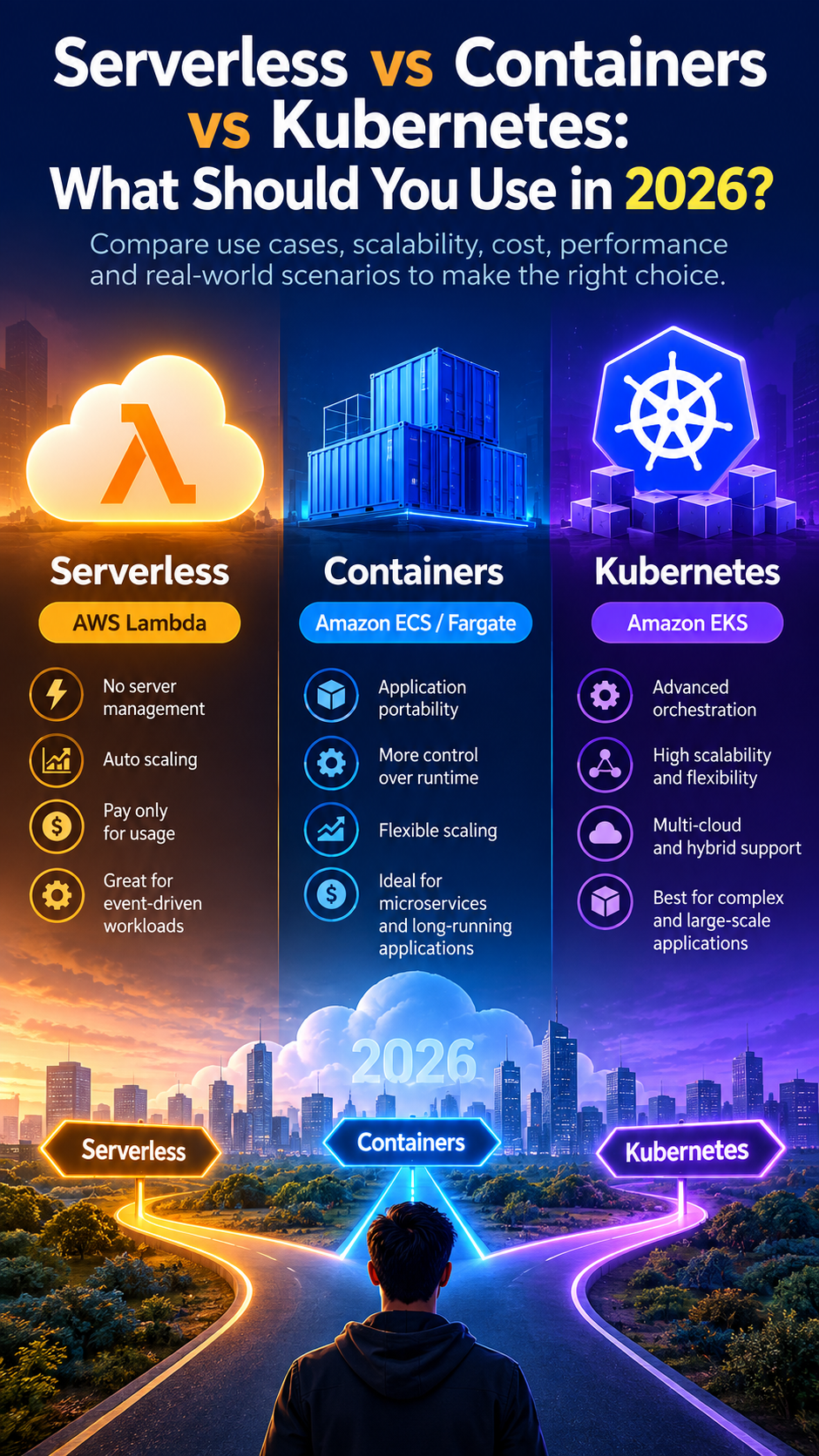
Serverless
With AWS Lambda, you run code without managing servers or clusters directly. Lambda is designed around an event-driven execution model and automatically handles much of the infrastructure required to run and scale the workload.
Typical use cases include:
- Event-driven applications
- API backends
- Data processing
- File processing
- Automation
- Lightweight microservices
Containers
Containers package an application together with its runtime dependencies, creating a consistent unit that can be deployed across environments.
On AWS, containers can run through services such as Amazon ECS and AWS Fargate.
Containers are useful when you need more control over the application environment without necessarily taking on the operational complexity of Kubernetes.
Kubernetes
Kubernetes is an open-source platform for automating the deployment, scaling, and management of containerized applications.
On AWS, Amazon EKS provides managed Kubernetes.
Kubernetes becomes particularly relevant when organizations have complex containerized workloads, multiple services, hybrid requirements, or a need for the broader Kubernetes ecosystem.
---
Serverless vs Containers vs Kubernetes
Here's the simplest way to think about the three:
Area| Serverless| Containers| Kubernetes
Infrastructure management| Very low| Low to moderate| Moderate to high
Control| Lower| Higher| Very high
Scaling| Highly automated| Automated/configurable| Highly configurable
Portability| Lower| High| Very high
Operational complexity| Low| Moderate| High
Best suited for| Event-driven workloads| Applications & microservices| Complex container platforms
AWS examples| Lambda| ECS, Fargate| EKS
Team expertise required| Lower| Moderate| Higher
The table isn't a ranking.
It's a way to understand the trade-offs.
---
1. When Should You Choose Serverless?
Serverless makes sense when you want your development team to spend more time writing application logic and less time managing infrastructure.
AWS describes Lambda as a serverless, event-driven compute service where AWS manages the underlying execution environment and scaling.
Imagine this workflow:
A customer uploads a document → event occurs → Lambda processes it → result is stored.
You don't necessarily need a continuously running server for that workflow.
Serverless can be particularly attractive when:
- Traffic is unpredictable
- Workloads are event-driven
- Applications consist of smaller functions
- You want minimal infrastructure management
- You want automatic scaling
- You don't need extensive control over the underlying runtime
AWS also identifies event-driven processing, API backends, data transformation, and real-time file processing as common Lambda use cases.
But serverless isn't automatically the answer.
You may need containers instead if you require:
- Long-running workloads
- More control over the runtime
- Specialized dependencies
- Greater portability
- Container-based deployment workflows
- Workloads that don't fit naturally into a function-oriented architecture
AWS's current guidance notes that Lambda is particularly suited to on-demand workloads, while ECS can be appropriate when workloads need to run longer or require deployment outside AWS Regions.
---
2. When Should You Choose Containers?
Containers sit somewhere between traditional servers and highly managed serverless services.
You package the application and its dependencies into a container image.
Then you decide where and how that container should run.
This gives developers considerably more control than a typical serverless function.
On AWS, you can use Amazon ECS, AWS Fargate, or other container options depending on your requirements.
Amazon ECS is AWS's native container orchestration service, while Fargate allows containers to run without managing servers yourself.
Containers can be a strong fit for:
- Microservices
- APIs
- Web applications
- Background workers
- Batch processing
- Application modernization
- Long-running services
They're also useful when you're migrating an existing application.
Instead of completely redesigning the application for serverless, you can package it into containers and modernize the infrastructure incrementally.
AWS specifically identifies containers as useful for packaging code, configuration, and dependencies while providing portability and flexibility.
---
3. When Should You Choose Kubernetes?
Kubernetes gives you significantly more control over how containers are deployed, scheduled, scaled, and managed.
But that control comes with complexity.
Kubernetes itself provides mechanisms for deploying applications, scaling workloads, updating applications, and managing containerized workloads.
Kubernetes can make sense when you have:
- Many containerized services
- Complex deployment requirements
- Advanced scheduling requirements
- Hybrid or multi-cloud requirements
- A strong Kubernetes engineering team
- Existing Kubernetes expertise
- A need for the broader Kubernetes ecosystem
AWS provides Amazon EKS as its managed Kubernetes service.
With EKS, AWS manages the Kubernetes control plane while teams still work within the Kubernetes ecosystem.
But there's an important consideration.
Don't choose Kubernetes simply because your application is successful.
A small application doesn't automatically need a Kubernetes cluster.
If your application can run effectively on a simpler platform, introducing Kubernetes may add operational complexity without solving a real problem.
Kubernetes' own production guidance emphasizes planning around availability, security, access control, resource management, and the operational responsibilities involved in running production clusters.
---
The Biggest Question: How Much Control Do You Need?
This is where the decision becomes easier.
Think of the spectrum like this:
Serverless → Containers → Kubernetes
As you move from left to right, you generally gain more control and flexibility—but you also take on more infrastructure and operational responsibility.
Serverless
You focus primarily on your code.
Containers
You control the application environment and container configuration.
Kubernetes
You gain extensive control over how containerized workloads are orchestrated.
None of these is inherently the correct choice for every application.
---
What About Cost?
This is where many architecture discussions go wrong.
People often ask:
"Which is cheaper?"
There isn't a universal answer.
Cost depends on:
- Traffic patterns
- CPU usage
- Memory requirements
- Number of services
- Utilization
- Scaling behavior
- Infrastructure configuration
- Operational overhead
- Engineering resources
For example, Lambda uses a consumption-oriented pricing model based on requests and compute duration. Fargate charges based on the resources allocated to container workloads. EKS adds cluster/control-plane costs alongside the underlying compute resources.
But there's another cost businesses sometimes forget:
Engineering time.
A technology that looks inexpensive on the infrastructure bill can become expensive if it requires significant engineering effort to operate.
That's why cloud cost optimization should consider total cost of ownership, not simply the monthly infrastructure invoice.
---
What About AI Workloads?
This is becoming an increasingly important consideration in 2026.
AI applications can involve:
- Model inference
- Data processing
- APIs
- Background jobs
- Vector databases
- GPU workloads
- Batch processing
- Model pipelines
Different parts of the same AI application may use different compute models.
For example:
API layer → Serverless
Application services → Containers
Complex ML workloads → Kubernetes
You don't necessarily need to choose one technology for everything.
Modern cloud architectures can combine multiple approaches based on workload requirements.
AWS itself notes that organizations may use different modern application approaches across workloads and teams rather than applying one strategy everywhere.
---
A Practical Decision Framework
Ask these questions before choosing your architecture.
Question 1: Is the workload event-driven?
If yes, serverless may be worth evaluating.
Question 2: Does the application need a custom runtime?
If yes, containers may provide more flexibility.
Question 3: Do you have many complex containerized services?
Kubernetes may become relevant.
Question 4: Does the workload need to run continuously?
Containers or Kubernetes may be more appropriate depending on the architecture.
Question 5: Does your team already know Kubernetes?
If not, consider whether the operational complexity is justified.
Question 6: Do you need hybrid or multi-cloud portability?
Containers and Kubernetes may offer advantages depending on your requirements.
Question 7: Is infrastructure management distracting developers from product development?
A more managed service may be worth considering.
---
You Don't Have to Pick Just One
This is probably the biggest misconception in the serverless vs containers vs Kubernetes debate.
A modern application can use all three.
For example:
AWS Lambda
→ Handles event-driven processing
Amazon ECS/Fargate
→ Runs application containers
Amazon EKS
→ Runs complex Kubernetes workloads
This hybrid approach allows teams to choose the appropriate compute model for each workload instead of forcing every application into the same architecture.
AWS's modern application guidance explicitly recognizes that teams may combine approaches based on workload requirements.
---
So, What Should You Use in 2026?
Instead of asking:
"Is serverless better than Kubernetes?"
Ask:
"What does this workload actually require?"
Choose serverless when simplicity, event-driven execution, and reduced infrastructure management are priorities.
Choose containers when you need application portability and more control over the runtime without necessarily adopting Kubernetes.
Choose Kubernetes when your workload and organization genuinely benefit from advanced container orchestration, portability, or the Kubernetes ecosystem.
And don't be afraid to combine them.
The strongest cloud architecture isn't necessarily the one using the most advanced technology.
It's the one where the technology matches the workload.
Final Takeaway
There is no universal winner in the serverless vs containers vs Kubernetes debate.
The real decision is about trade-offs.
Less infrastructure management? → Consider serverless.
More runtime control and portability? → Consider containers.
Complex container orchestration and broader Kubernetes requirements? → Consider Kubernetes.
The goal in 2026 shouldn't be to use the trendiest architecture.
It should be to build an infrastructure that is scalable, secure, maintainable, cost-aware, and aligned with the actual needs of the business.
Because sometimes the smartest cloud architecture is the one that uses less technology—not more.
Did you find this helpful?